




1099-NEC for Real Estate Brokerages: 2026 Rules and Steps
Every January, broker-owners have the same scramble: pull a year of commission payouts, chase missing W-9s, figure out which agents are set up as S corporations, and get Form 1099-NEC filed before the deadline. For 2026 payments the routine has a twist. The reporting threshold for Form 1099-NEC jumped from $600 to $2,000, so the list of payees who need a form is different from last year's, and copying last year's process will produce the wrong set of forms.
Here is the thesis of this guide. 1099-NEC season goes smoothly for a real estate brokerage when three things are settled before December 31: you know which payees are reportable, you have a valid W-9 for each of them, and your payout records add up to one total per payee. Everything after that is filing mechanics.
This guide is for broker-owners, managing brokers, office administrators, and the bookkeepers who support them. You will get the 2026 rule changes, a decision flowchart, a payee-by-payee table, a year-end checklist, the deadline calendar, the penalty schedule, and the mistakes that cause the most rework.
Scope note: this is an operating guide, not tax or legal advice. The figures below come from IRS publications listed in the Sources section, and they can change. Confirm your situation with a CPA or tax attorney, and check your state's own information-return rules.
Related reading: the 1099 status of your agents starts with the contract, so see the real estate independent contractor agreement guide. Referral payments are covered in the real estate referral agreement template, and the accounting side of payouts is in real estate commission accounting and compliance.
In this guide
- What changed for 2026: the $2,000 threshold
- Why most agents get a 1099-NEC, not a W-2
- The decision flowchart: does this payment need a 1099-NEC?
- Who gets what at a brokerage (payee table)
- Worked example: one brokerage, seven payees
- W-9s, TIN matching, and backup withholding
- Deadlines for the 2026 tax year
- How to file: e-file, IRIS, and the 10-return rule
- Penalties for late or wrong forms
- Year-end 1099-NEC checklist for brokerages
- Mistakes that cause the most rework
- How Brokurz fits
- FAQ
What changed for 2026: the $2,000 threshold
Per the IRS Instructions for Forms 1099-MISC and 1099-NEC (Rev. December 2026), for tax years beginning after 2025 the minimum threshold for reporting certain payments, and for backup withholding on those payments, increased to $2,000, and it may be adjusted for inflation beginning in calendar year 2027. The IRS page "Am I required to file a Form 1099 or other information return?" states it plainly: the threshold is $600 for payments made before 2026 and $2,000 for payments made in 2026, with the inflation-adjusted figure for later years published in Pub. 1099.
The change comes from section 70433 of the One, Big, Beautiful Bill Act (Public Law 119-21), as noted in IRS internal guidance on that section.
What that means for a brokerage in practice:
- Fewer forms for small payees. A new agent who closed one small deal in December, a one-time photographer, or a part-time transaction coordinator paid under $2,000 for the year no longer needs a 1099-NEC, unless you backup-withheld on them.
- The income is still taxable. A lower filing obligation for you does not change what the payee owes. Your records should still show every payment.
- Box numbers moved. Nonemployee compensation is now reported in box 1a. The December 2026 revision also added boxes for cash tips, tipped occupation codes, and overtime, which most brokerages will leave blank.
- One exception stays at $600. The same instructions still list "at least $600 in gross proceeds paid to an attorney" for box 10 of Form 1099-MISC. That covers payments to an attorney that are not for the attorney's own services, such as some settlement payments. Attorneys' fees for services follow the $2,000 rule on Form 1099-NEC.
Why most agents get a 1099-NEC, not a W-2
The IRS treats licensed real estate agents as statutory nonemployees. Per the IRS page on licensed real estate agents, they are treated as self-employed for all federal tax purposes, including income and employment taxes, if two conditions are met:
- Substantially all payments for their services as real estate agents are directly related to sales or other output, rather than to the number of hours worked.
- Their services are performed under a written contract providing that they will not be treated as employees for federal tax purposes.
The statute behind this, 26 U.S.C. § 3508, adds the obvious third condition: the individual must be a licensed real estate agent.
Two practical takeaways. First, the written contract is not optional paperwork. If an agent has no signed independent contractor agreement with the "not treated as an employee" language, fix that now, not in January. Second, anyone you pay a salary or hourly wage, such as an office manager or a salaried assistant, is a different question. Their pay goes on Form W-2, not Form 1099-NEC.
The decision flowchart: does this payment need a 1099-NEC?
The IRS instructions give four conditions for nonemployee compensation: you paid someone who is not your employee, for services in the course of your trade or business, to an individual, partnership, estate, or in some cases a corporation, and the payments to that payee totaled at least $2,000 for the year. Add the payment-method rule and you get five questions.
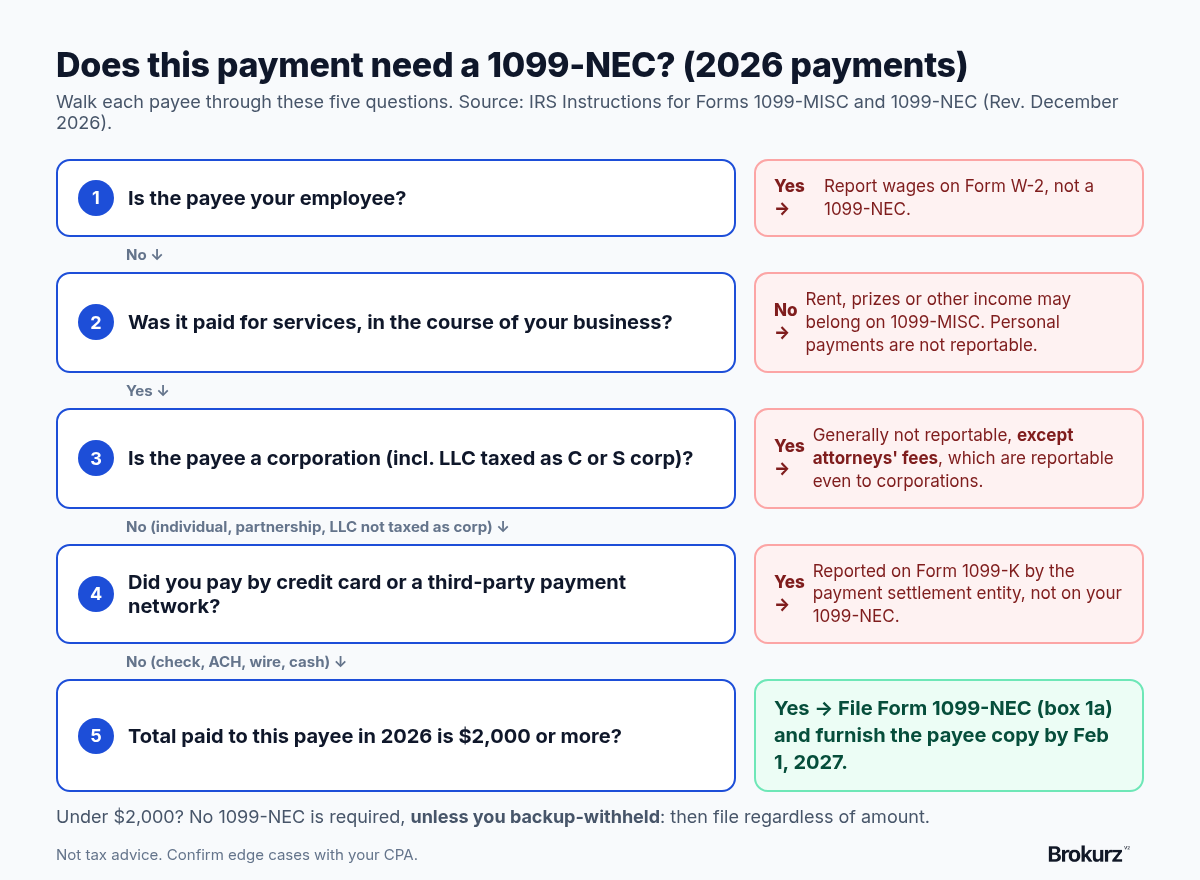
A few notes on the questions:
- Corporations. The instructions say payments to a corporation, including an LLC treated as a C or S corporation, are generally not reportable on Form 1099-MISC or 1099-NEC. Attorneys' fees are the main exception: they are reportable even when the law firm is a corporation. This is why the W-9 tax classification box matters so much at a brokerage. Many agents are paid through an S corporation.
- Card and payment networks. Per the same instructions, payments made by credit card or payment card, and certain other payments including third-party network transactions, are reported on Form 1099-K by the payment settlement entity and are not subject to reporting on Form 1099-MISC or 1099-NEC.
- Commission advances. The instructions list "commissions paid to nonemployee salespersons that are subject to repayment but not repaid during the calendar year" as reportable nonemployee compensation. If you advance commission to an agent in December on a deal that closes in January, talk to your CPA about the timing before you total that agent's year.
Who gets what at a brokerage
This table maps common brokerage payees to the form the IRS instructions point to. "Not a corporation" means an individual, sole proprietor, partnership, or an LLC that is not taxed as a corporation.
| Payee | Typical payment | Form for 2026 payments |
|---|---|---|
| Agent paid as an individual or single-member LLC | Commission splits, bonuses | 1099-NEC box 1a if $2,000 or more |
| Agent paid through an S corporation or C corporation | Commission splits | Generally no 1099 (corporation exception) |
| Another brokerage (not a corporation) | Referral fee | 1099-NEC if $2,000 or more. The IRS lists "fee-splitting or referral fees" between professionals as nonemployee compensation |
| Another brokerage taxed as a corporation | Referral fee | Generally no 1099 |
| Attorney or law firm, including a professional corporation | Legal fees | 1099-NEC box 1a if $2,000 or more, even if incorporated |
| Freelance transaction coordinator, photographer, stager, IT contractor | Service fees | 1099-NEC if $2,000 or more and not a corporation |
| Top-producer award paid to an agent | Cash award for performance | 1099-NEC (the instructions say awards for services by nonemployees go in box 1a, not 1099-MISC box 3) |
| Landlord for your office space | Rent | 1099-MISC box 1 if $2,000 or more. Not required if paid to a real estate agent or property manager, who reports the rent paid over to the owner |
| Salaried or hourly office staff | Wages | Form W-2 |
| Anyone paid by card or a payment network | Any | Reported on 1099-K by the payment settlement entity |
If you also manage property, note the rent rule in the instructions: a real estate agent or property manager who collects rent must use Form 1099-MISC to report the rent paid over to the property owner. And Form 1099-S is a different form entirely. It reports proceeds from real estate transactions to the seller (the transferor), not commissions. Per Pub. 1099, the 1099-S statement is furnished by February 15, and starting in tax year 2026, digital assets used in the sale or exchange of real estate are reported on Form 1099-S.
Worked example: one brokerage, seven payees
Here is how the 2026 rules apply to a hypothetical 20-agent brokerage. The names and amounts are illustrative, not real people.
| Payee | Entity (from W-9) | 2026 total paid | 1099-NEC? |
|---|---|---|---|
| Agent A | Individual / sole proprietor | $64,000 | Yes, $64,000 in box 1a |
| Agent B | S corporation | $112,000 | Generally no |
| Agent C (joined in November) | Individual | $1,800 | No. Under $2,000 (would have been yes under the old $600 rule) |
| Out-of-state referring broker | LLC taxed as a partnership | $3,600 referral fee | Yes |
| Real estate attorney | Professional corporation | $2,500 | Yes. The corporation exception does not apply to legal fees |
| Listing photographer | Individual | $2,400 | Yes |
| Agent D, paid through a payment app | Individual | $5,000 | No 1099-NEC from you; the payment settlement entity reports it on 1099-K, if its own threshold is met |
Two lessons from this table. The $2,000 test is applied per payee, per year, so it only works if each payee has one clean total. And entity type decides more forms than dollar amount does, which is why the W-9 is the most important document in this process.
W-9s, TIN matching, and backup withholding
Collect Form W-9 at onboarding, not at year-end. Per the IRS, Form W-9 is how a payee gives you their correct taxpayer identification number (TIN). Make it part of the agent onboarding packet and part of vendor setup, and refuse to issue a first payout without it.
Check names against TINs before you file. Pub. 1099 describes the IRS TIN Matching program, an e-services tool that lets a payer match name and TIN combinations against IRS records before filing Forms 1099-NEC and 1099-MISC. The IRS says payers who validate first should receive fewer backup withholding (CP2100) notices and penalty notices. The usual mismatch at a brokerage is an agent who gave a personal SSN but is paid through an LLC, or the reverse.
Know when backup withholding applies. Per Pub. 1099, nonemployee compensation and commissions may be subject to backup withholding at a 24% rate, for example when a payee does not furnish a TIN. Backup withholding is reported on Form 945, and you must file a Form 1099-NEC for anyone you backup-withheld on regardless of the amount. That is the one case where a payee under $2,000 still gets a form.
Deadlines for the 2026 tax year
Per the IRS instructions, section 6071(c) requires you to file Form 1099-NEC on or before January 31, on paper or electronically. Payee copies are also due January 31. When a due date falls on a Saturday, Sunday, or legal holiday, Pub. 1099 says filing or furnishing is timely on the next business day. January 31, 2027 is a Sunday, so the practical deadline for 2026 forms is Monday, February 1, 2027.
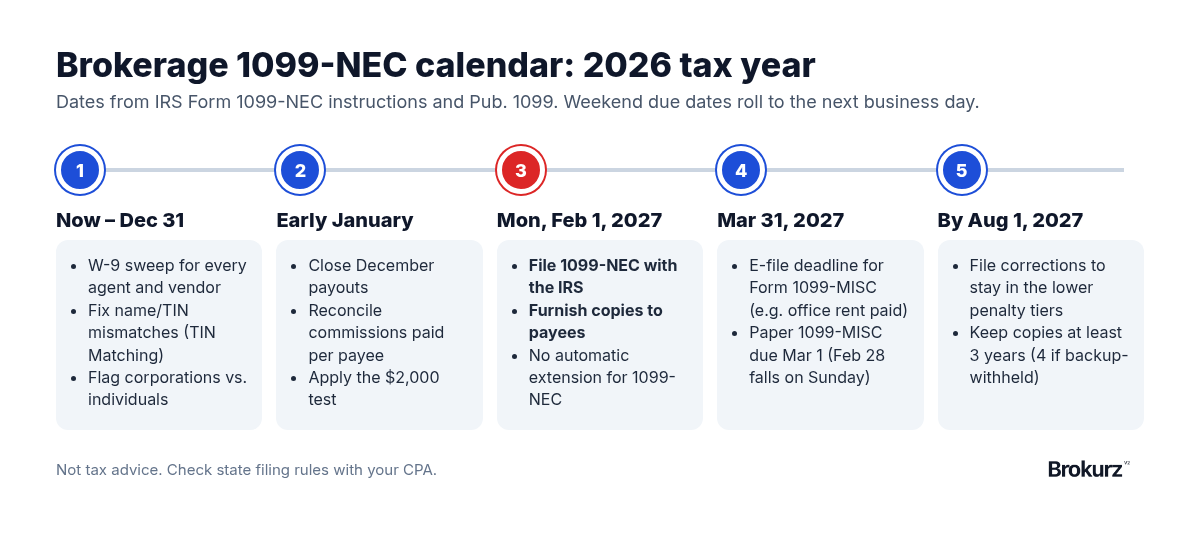
Other dates that matter:
- No automatic extension. Pub. 1099 says Form 8809 gives an automatic 30-day extension for most information returns, but for Forms W-2 and 1099-NEC no automatic extension is available.
- Form 1099-MISC (for example, office rent) is due February 28 on paper or March 31 if e-filed. February 28, 2027 is a Sunday, so paper filers have until Monday, March 1, 2027.
- Corrections by August 1 keep a late or wrong return in a lower penalty tier (see the penalties section).
- Recordkeeping. Per Pub. 1099, keep copies of filed information returns, or the ability to reconstruct the data, for at least 3 years from the due date, or 4 years if backup withholding was imposed.
How to file: e-file, IRIS, and the 10-return rule
If you file 10 or more information returns in total during the year, you must e-file. The IRS counts that threshold by aggregating all information returns, so a brokerage with six agent 1099-NECs, two vendor 1099-NECs, a 1099-MISC for rent, and W-2s for staff can easily cross it. Paper filing is realistic only for very small offices.
Your e-file options:
- IRIS Taxpayer Portal. The IRS Information Returns Intake System is a free, web-based portal. Per the IRS, it lets you e-file up to 100 returns at a time, enter forms manually or by CSV upload, download payee copies, and file corrections and extension requests.
- Get a Transmitter Control Code early. IRIS requires an IRIS Transmitter Control Code (TCC). The IRS says TCC applications can take up to 45 days to process. If you have never e-filed, apply in November or early December, or you may run out of time before February 1.
- Accounting software or a filing service. Many brokerages file through their accounting system or a third-party filer. That works well as long as the payee totals you feed it are reconciled.
Also check your state. Some states require their own copy of 1099 data. Pub. 1099 points filers to the IRS Combined Federal/State Filing (CF/SF) Program, but which states and forms it covers varies, so confirm your state's filing rules with your CPA.
Penalties for late or wrong forms
The IRS charges separate penalties for failing to file a correct information return on time and for failing to give the payee a correct statement on time. Per the IRS page on information return penalties, for returns and statements due in 2027:
| When the correct return is filed | Penalty per return | Annual max, small business | Annual max, large business |
|---|---|---|---|
| Up to 30 days late | $60 | $244,500 | $698,500 |
| 31 days late through August 1 | $130 | $698,500 | $2,095,500 |
| After August 1, or not filed | $340 | $1,397,000 | $4,191,500 |
| Intentional disregard | $690 | No maximum | No maximum |
Pub. 1099 defines a small business for this purpose as average annual gross receipts of $5 million or less for the 3 most recent tax years. It also describes relief for failures due to reasonable cause and a de minimis rule for timely returns corrected by August 1.
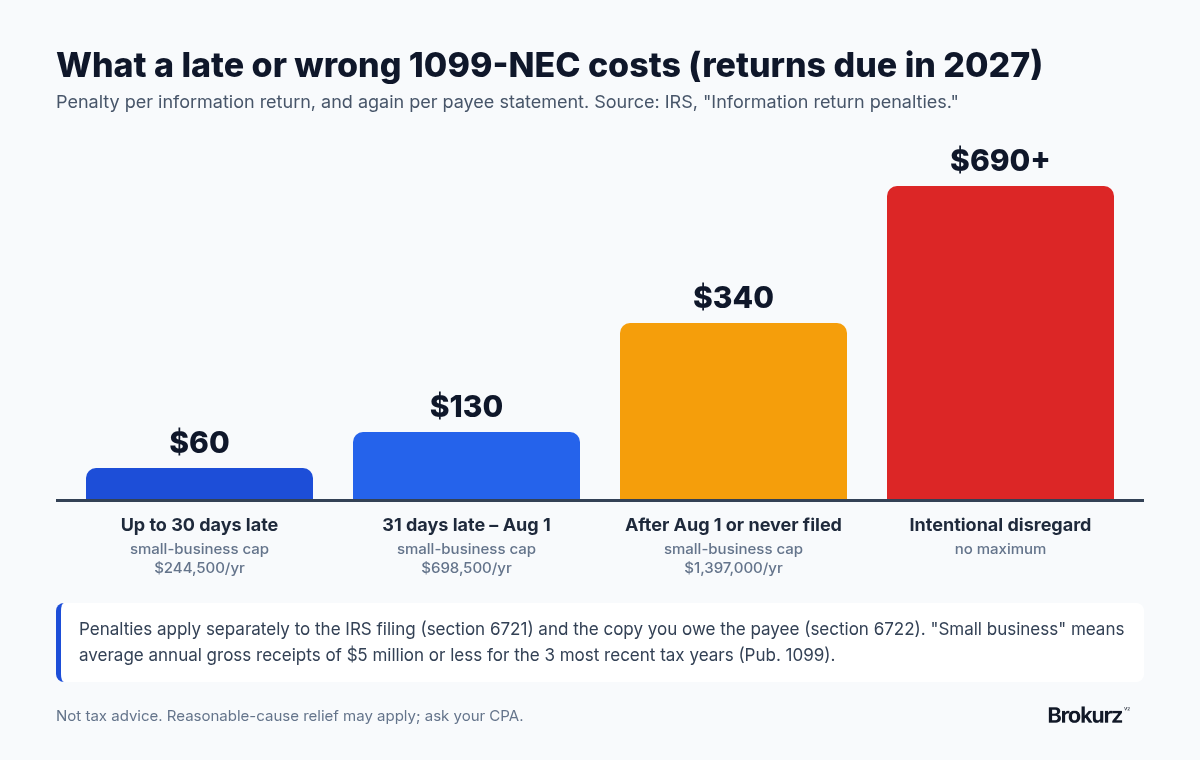
Because the filing penalty and the payee-statement penalty are separate, a late form can cost twice the per-return figure. For a brokerage with 40 agents, a missed deadline adds up quickly.
Year-end 1099-NEC checklist for brokerages
Work through this list in order. The first half belongs in November and December.
November–December 31
- Pull every payee you paid in 2026: agents, referral partners, attorneys, contractors, landlords.
- Confirm a current Form W-9 for each one, with the tax classification box completed.
- Flag every payee that is a corporation or an LLC taxed as one, and every attorney (attorneys stay reportable).
- Run names and TINs through IRS TIN Matching, and fix mismatches with the payee.
- Check that every agent has a signed independent contractor agreement with the "not treated as an employee for federal tax purposes" language.
- Apply for an IRIS TCC now if you will e-file through IRIS for the first time.
- Decide with your CPA how commission advances and fees deducted from payouts are handled, and apply the rule to every agent.
January 1 – February 1, 2027
- Close December payouts and confirm no 2026 checks are still unrecorded.
- Produce one 2026 total per payee from your payout records, and tie it to your bank and trust account records.
- Separate card and payment-network payments, which are reported on 1099-K by the payment settlement entity.
- Apply the $2,000 test to the remaining totals, and add any payee you backup-withheld on regardless of amount.
- Classify each amount: 1099-NEC box 1a (commissions, referral fees, legal fees, services, performance awards) or 1099-MISC (rent).
- E-file Forms 1099-NEC and furnish payee copies by February 1, 2027.
- Archive the filed returns, the W-9s, and the payee totals for at least 3 years (4 if you backup-withheld).
Mistakes that cause the most rework
- Using last year's $600 list. For 2026 payments, payees under $2,000 generally drop out (unless you backup-withheld). Sending forms nobody needed confuses agents and creates extra work.
- Ignoring the entity on the W-9. Sending a 1099-NEC to an agent's S corporation, or skipping a sole proprietor because their business has a trade name, are both common. The tax classification box decides it.
- Forgetting that attorneys are different. The corporation exception does not apply to legal fees.
- Totals that do not tie out. If an agent's 1099-NEC does not match the payout statements you sent during the year, expect a call in February. Reconcile before you file.
- Waiting on the TCC. A 45-day processing window and a February 1 deadline do not mix.
- Assuming an extension. There is no automatic extension for Form 1099-NEC.
- Leaving W-9s for January. Agents who left the brokerage are the hardest to reach. Collect W-9s at onboarding and confirm them in December.
How Brokurz fits
Brokurz is the AI operating system for real estate: transactions, compliance, commissions, CRM, back office, website, and recruiting in one place. For 1099 season, the benefit is simple. When agent onboarding, commission payouts, and back-office records live in one system, the year-end total for each payee comes from the same records that paid them, instead of being rebuilt from a spreadsheet, a bank export, and an inbox full of W-9 PDFs. That is what makes the $2,000 test, the entity check, and the reconciliation fast.
Brokurz 2.0 is now live. Read the details in Introducing Brokurz 2.0.
Lock in today's rate before December 1. New customers who sign up by November 30 keep today's price; prices go up December 1, and existing customers keep their rate. Sign up for Brokurz or book a demo to see commissions, agent records, and back office run in one system before year-end.
FAQ
Do real estate brokerages have to issue 1099-NEC forms to agents?
Generally yes, for agents who are not employees and were paid $2,000 or more in 2026, unless the agent is paid through a corporation (including an LLC taxed as a C or S corporation). Licensed agents working under a written contract and paid on output are statutory nonemployees under 26 U.S.C. § 3508.
What is the 1099-NEC threshold for 2026?
$2,000 per payee for payments made in 2026, up from $600 for payments made before 2026. The IRS says the threshold may be adjusted for inflation beginning in 2027, with the figure published in Pub. 1099.
When is Form 1099-NEC due for 2026 payments?
The statutory date is January 31. Because January 31, 2027 is a Sunday, filing with the IRS and furnishing payee copies are timely on Monday, February 1, 2027. There is no automatic extension for Form 1099-NEC.
Do I send a 1099-NEC to an agent's S corporation?
Generally no. The IRS instructions exempt most payments to corporations, including LLCs taxed as C or S corporations. Get a current W-9 so you know the classification, and confirm with your CPA.
Are referral fees paid to other brokers reported on a 1099-NEC?
The IRS lists fee-splitting and referral fees paid by one professional to another as nonemployee compensation. If the receiving brokerage is not a corporation and you paid it $2,000 or more in 2026, it generally gets a 1099-NEC.
What if an agent never returned a W-9?
You may be required to backup-withhold 24% on reportable payments, report the withholding on Form 945, and file a 1099-NEC for that agent regardless of amount. Make the W-9 a condition of the first payout.
Does the brokerage file Form 1099-S on its sales?
Form 1099-S reports proceeds from real estate transactions to the seller and is a separate obligation from 1099-NEC. Check the Instructions for Form 1099-S to see who the reporting person is on your transactions.
How long should a brokerage keep 1099 records?
Per Pub. 1099, at least 3 years from the due date of the returns, or 4 years if federal backup withholding was imposed. Your state may require longer retention for brokerage records.
Sources
- IRS, Instructions for Forms 1099-MISC and 1099-NEC (Rev. December 2026): https://www.irs.gov/instructions/i1099mec
- IRS, Publication 1099 (2026), General Instructions for Certain Information Returns: https://www.irs.gov/publications/p1099
- IRS, "Am I required to file a Form 1099 or other information return?": https://www.irs.gov/businesses/small-businesses-self-employed/am-i-required-to-file-a-form-1099-or-other-information-return
- IRS, "Information return penalties": https://www.irs.gov/payments/information-return-penalties
- IRS, "Licensed real estate agents – Real estate tax tips": https://www.irs.gov/businesses/small-businesses-self-employed/licensed-real-estate-agents-real-estate-tax-tips
- 26 U.S.C. § 3508, Treatment of real estate agents and direct sellers: https://uscode.house.gov/us/usc/119-138/t26/s3508/
- IRS, "About Form W-9": https://www.irs.gov/forms-pubs/about-form-w-9
- IRS, "E-file information returns with IRIS": https://www.irs.gov/filing/e-file-information-returns-with-iris
- IRS interim guidance incorporating section 70433 of the One, Big, Beautiful Bill Act (SBSE-04-0426-0432): https://www.irs.gov/pub/foia/ig/spder/sbse-04-0426-0432.pdf
Stay updated
Real estate tech and brokerage insights, weekly.