Company Dollar in Real Estate: How Brokers Measure It
Operations
Company Dollar in Real Estate: How Brokers Measure It
Company dollar is what your brokerage keeps after agents and outside brokers are paid. This guide covers the formula, worked examples, how splits and caps move it, break-even math, and a monthly tracker.
A brokerage that closes $4.2 million in commissions and keeps $600,000 of it is a very different business from one that keeps $1.6 million. The number that tells those two apart is company dollar. If you are a broker-owner, company dollar real estate math is the first thing to get right, because it is the only revenue figure that actually pays your rent, your staff, your software, and you.
This guide explains what company dollar is, the formula, how splits, caps, and fees move it, how to track it monthly, and where brokers go wrong. It is written for broker-owners and brokers-in-charge who want one definition they can defend in a budget meeting, a recruiting conversation, or a lender's office. The worked examples are illustrative arithmetic, not industry benchmarks, and the definitions come from the named sources at the end.
In this guide:
What company dollar is, and what it is not
The formula, with a worked month
How splits, caps, desk fees, and referral fees change it
Company dollar by agent: why your top producer may contribute the lowest rate
Company dollar is the money a brokerage keeps from commissions after it pays its agents. Keller Williams' public glossary of market center financial terms defines it as "Paid on GCI minus Cost of Sales," meaning the commission income on which the company is paid, minus the commissions paid to associates under their splits. The same glossary describes it as the money left to pay expenses, make a profit, and fund profit share.
Three terms make the definition easy to apply:
Gross commission income (GCI): the total commission the brokerage receives on closed transactions, before any agent is paid.
Agent payouts (cost of sales): the commissions paid to agents under their plans.
Company dollar: what is left after those payouts, and, depending on how your firm defines it, after referral fees and franchise fees paid out.
A fair caution: there is no single universal definition. A professional-funding firm that works with brokerage buyers notes that company dollar is usually described as what remains after agent splits, and sometimes after referral fees paid to other brokers or franchise fees, depending on how the firm defines it. An accounting firm that serves real estate companies says much the same: firms may treat referral fees, transaction charges, and caps differently, so write down what the measure includes at your firm. The rest of this guide uses the stricter version, which subtracts outbound referral fees, because it shows what you really keep.
What company dollar is not
Company dollar is not profit. It is revenue retained before operating costs. Greenkey Accounting puts it plainly: company dollar is a commission-retention measure under an agreed definition, and operating expenses and other costs still affect profit. It is also not GCI. A brokerage can advertise a large GCI and keep very little of it if its splits are rich.
The company dollar formula
The core formula is:
Company dollar = GCI − agent payouts − outbound referral fees (and franchise fees, if you include them)
The company dollar rate is company dollar divided by GCI. Track both. Dollars tell you whether the business is growing; the rate tells you whether the growth is profitable.
A worked month (illustrative)
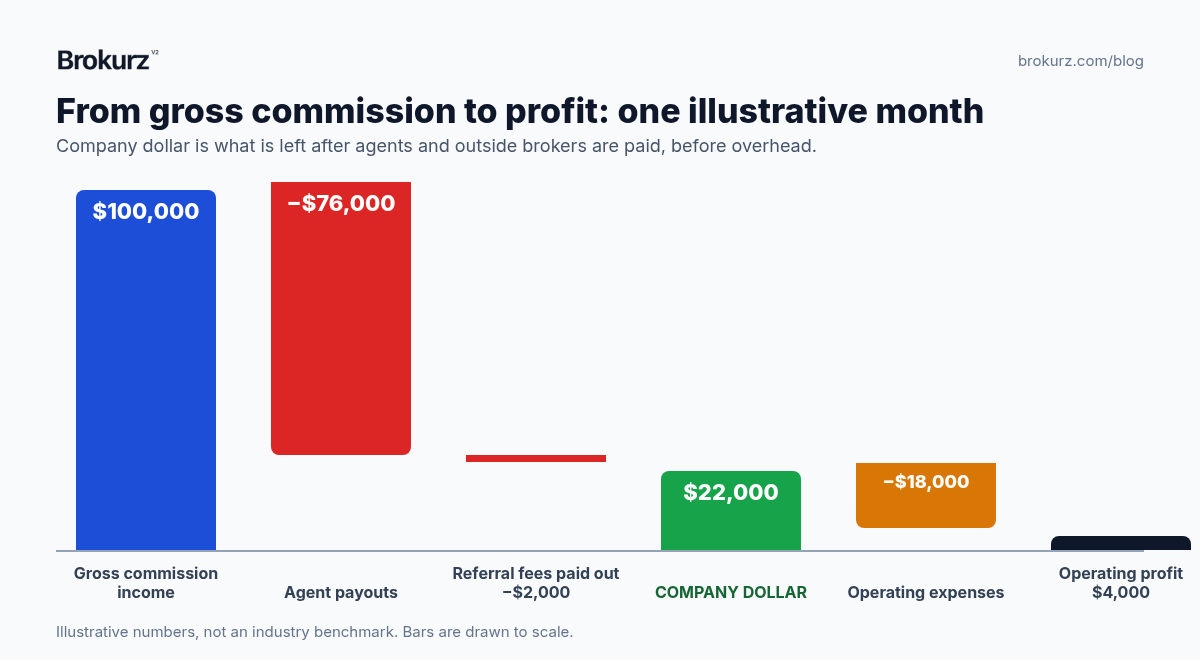
Suppose a brokerage collects $100,000 in GCI in a month. Agents are paid $76,000. The brokerage pays $2,000 in referral fees to out-of-area brokers. Operating expenses for the month are $18,000.
Line
Amount
Gross commission income
$100,000
Agent payouts
−$76,000
Referral fees paid out
−$2,000
Company dollar
$22,000
Company dollar rate
22%
Operating expenses
−$18,000
Operating profit
$4,000
Operating profit as a share of GCI
4%
Notice what the chart shows. The $100,000 number looks impressive, but $22,000 of it is available to run the company, and after expenses the owner is left with $4,000. This is the point the Florida broker-licensing study guide at OpenExamPrep makes: overhead is paid out of company dollar, never out of GCI, and any calculation that subtracts overhead directly from GCI gets the wrong answer.
Another source of confusion is the denominator. A long-running broker blog, the Set Fee Real Estate Blog, warns that profit percentage should be measured against gross revenue, not against company dollar, because measuring against company dollar can make a thin margin look several points higher. Pick one denominator, say which one it is, and keep it for the year.
What moves company dollar
Four mechanics decide how much of each commission you keep. Broker-owners often change one without checking what it does to the others.
1. Split plans
The split is the share of each commission paid to the agent and retained by the firm. A move from 70/30 to 75/25 on a $10,000 commission reduces company dollar on that deal from $3,000 to $2,500. Across a roster, small changes compound. A recruiting offer that wins a producer can also lower your company dollar rate if you give it to everyone.
2. Commission caps
A cap limits what an agent pays the firm in a plan year, after which the agent keeps a larger share. A funding-industry explainer on company dollar notes that caps can change how much the firm retains as agents become more productive, so buyers often review company dollar by agent and by month rather than relying on annual totals. The broker-software company Broker Simple adds a useful operating habit: track cap attainment, meaning cap credit earned year to date divided by the cap, and roll it up across the roster to forecast the dip in company dollar when producers cap. Anniversary-based plans stagger that effect; calendar-year plans concentrate it late in the year.
3. Desk fees, transaction fees, and technology fees
Some firms charge flat desk fees instead of or alongside splits, plus per-deal and per-month fees. Keller Williams' glossary lists desk fees as a type of "other income" that offsets operating expense in its profit-share model, which is a reminder that firms classify these differently. Decide whether each fee sits inside company dollar or beside it, and apply that rule every month.
4. Referral and franchise fees
Referral fees you pay to other brokers, and franchise fees where they apply, reduce what you keep. Whether they come out before company dollar or after depends on your definition. Keller Williams' glossary, for example, notes that cost of sales sometimes includes errors-and-omissions costs. Whichever way you go, be consistent.
Related guide: for the compliance side of paying referral fees, see our referral agreement guide.
Company dollar by agent: the top-producer trap
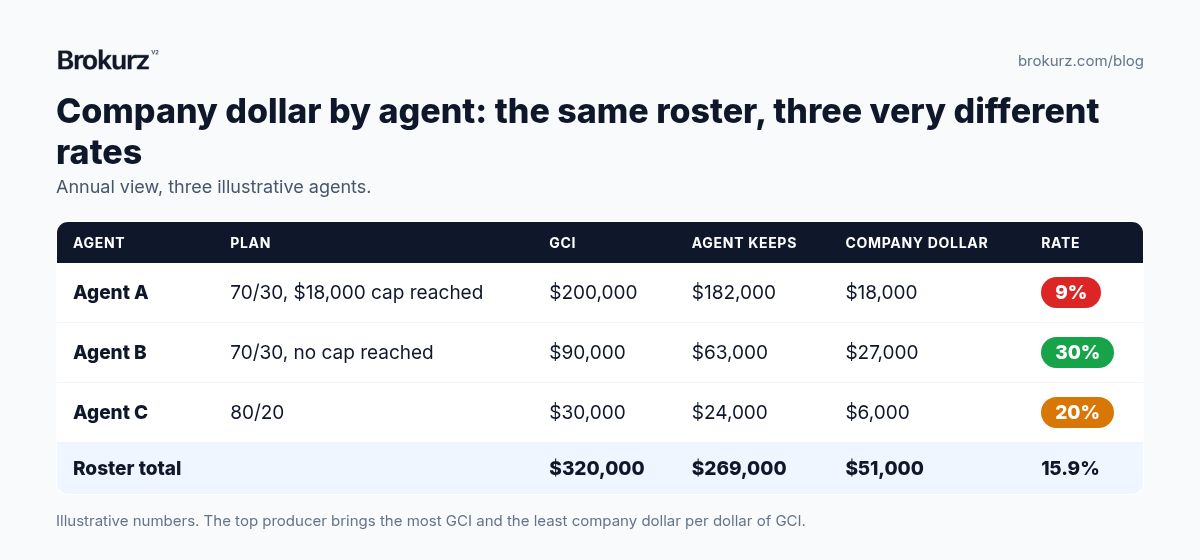
The average company dollar rate hides what each agent contributes. Here is an illustrative roster of three agents.
Agent
Plan
GCI
Agent keeps
Company dollar
Rate
Agent A
70/30, $18,000 cap reached
$200,000
$182,000
$18,000
9%
Agent B
70/30, cap not reached
$90,000
$63,000
$27,000
30%
Agent C
80/20
$30,000
$24,000
$6,000
20%
Roster total
$320,000
$269,000
$51,000
15.9%
Agent A is your biggest producer and your lowest company dollar rate. Agent B generates less than half the GCI and 50% more company dollar. Neither is a problem. The point is that you cannot judge agents, or forecast revenue, from GCI alone. The OpenExamPrep study guide makes the related point for forecasting: a projection built from a roster-wide average overstates revenue because production is skewed toward a small group, and applying one blended split to top-producer volume overstates company dollar. Forecast by tier, not by roster average.
It also changes retention math. Broker Simple's worked example shows that losing one producing agent is a revenue event: at an 18% company dollar rate, an agent who produced $180,000 in GCI is worth about $32,400 a year in company dollar. Use your own rate, and look at the specific agent's rate rather than the office average.
Break-even math: how much GCI covers your overhead
Because overhead is paid from company dollar, your monthly floor is simple:
Break-even GCI = operating expenses ÷ company dollar rate
With $18,000 in monthly expenses and a 22% rate, break-even GCI is about $81,800 a month. If your rate falls to 18%, break-even GCI rises to $100,000 for the same overhead. A three-point slide in rate costs you almost $20,000 in required GCI, which is why a falling rate deserves attention even when sides are rising.
A related planning rule from Broker Simple: compare each metric to your own prior periods rather than to industry averages, since plans, caps, and markets differ too much for one benchmark.
Weighted pipeline in company dollar terms
You can convert pipeline into expected company dollar. Broker Simple's example multiplies expected commission by a stage probability, sums it, and applies the company dollar rate to estimate the next 60 days of retained revenue. Compare that figure to fixed costs for an early warning.
The monthly company dollar tracker
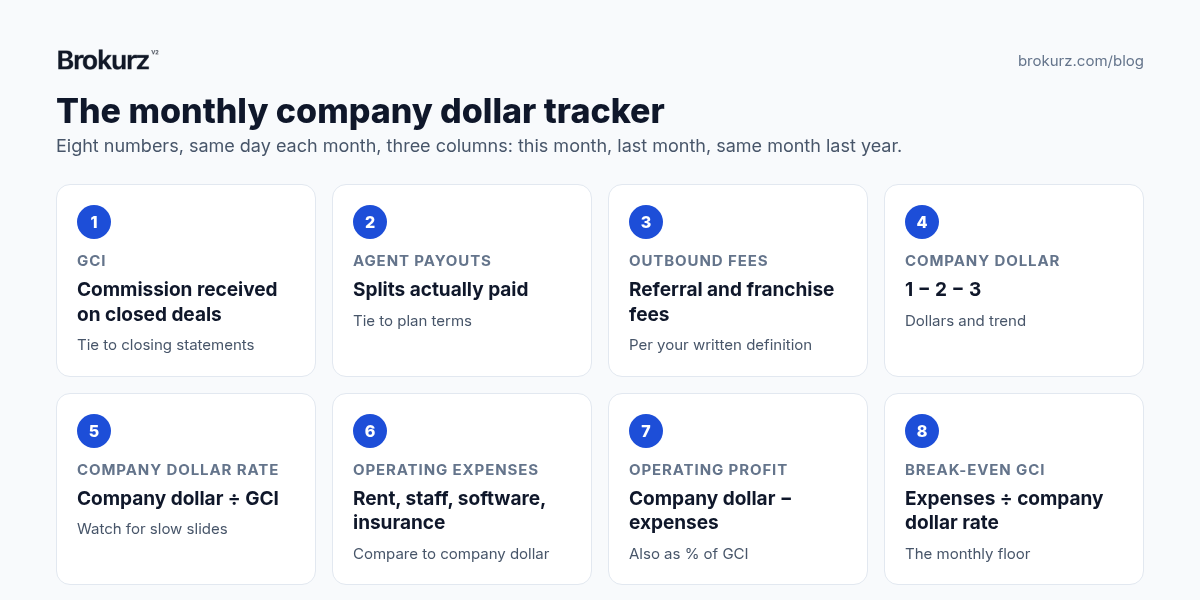
Pick one day a month, such as the fifth business day, and fill in the same eight lines each time. Compare this month, last month, and the same month last year, because real estate is seasonal.
GCI, tied to closing statements.
Agent payouts, tied to plan terms.
Outbound fees, per your written definition.
Company dollar (1 − 2 − 3).
Company dollar rate (company dollar ÷ GCI).
Operating expenses.
Operating profit (company dollar − expenses), also as a percentage of GCI.
Break-even GCI (expenses ÷ rate).
Add two columns that most brokers skip: company dollar by agent, and company dollar by deal type if you run teams, listings versus buyers, or a rental desk. Property management, leasing, and referral income should be reported separately, since each carries different risk.
Reconcile before you trust the number
A tracker is only as good as its inputs. The funding explainer lists four checks worth stealing: match commission reports to closing statements and bank deposits, compare agent payouts to agreements and plan terms, confirm how amounts held in trust are separated from operating revenue, and review any agents on special arrangements not reflected in standard plans. Greenkey adds a cash-timing caution: a profitable period can still produce cash pressure because receipts and payments fall on different dates. Keep a short view of expected closings next to commission obligations and operating bills.
Common mistakes with company dollar
Treating GCI as revenue you can spend. Most of it belongs to agents. Budget from company dollar.
Changing the definition mid-year. If referral fees move in or out of the formula, trends become meaningless. Write the definition down.
Using the office-average split. Tier your forecast, as above.
Ignoring cap timing. Producers capping in the same quarter can cut company dollar sharply. Forecast it.
Judging growth by sides alone. A brokerage can add sides three months running and still shrink if the rate slides, per Broker Simple.
Confusing company dollar with profit. After expenses, the number is smaller, sometimes much smaller.
Giving the best split to everyone. Reserve rich plans for measurable production, and review the effect on the rate.
Skipping reconciliation. Numbers that do not tie to closings and deposits are opinions.
Company dollar scorecard
Score each line 0 (no), 1 (partly), 2 (yes). Under 8 means you are guessing; 8 to 12 means you are close; 13 to 16 means you are running the brokerage on real numbers.
Question
0
1
2
Is your company dollar definition written down?
Do you calculate it monthly on a fixed day?
Do you track the rate as well as the dollars?
Can you see it by agent?
Do you forecast cap dates?
Do you know your break-even GCI?
Does it reconcile to closings and deposits?
Do you review it before changing any split?
Setting company dollar targets for 2027
If you are planning next year, build it from the bottom up. Start with the agents you expect to produce, not the roster count. Apply each tier's plan, include expected cap dates, and subtract outbound fees. That gives expected company dollar. Compare it to a realistic operating budget, then back into the required GCI with the break-even formula. Our year-end checklist covers the rest of the planning calendar, including drafting 2027 targets and announcing plan changes in writing.
How Brokurz helps
Brokurz is the AI operating system for real estate: transactions, compliance, commissions, CRM, back office, website, and recruiting in one place. For company dollar, the practical advantage of one system is that commission data, transaction records, and agent plans sit together, so the numbers on your tracker come from the same place as the deals instead of from a spreadsheet rebuilt each month. If you want to see how that would work for your plans and caps, book a demo.
Lock in today's rate before December 1. New customers who sign up by November 30 keep today's price; prices go up December 1, and existing customers keep their rate.
This guide is general business information, not legal, tax, or accounting advice. Definitions and reporting rules vary by firm and state; check with your CPA and your state real estate commission.
FAQ
What is company dollar in real estate?
Company dollar is the money a brokerage keeps from commissions after paying agents, and sometimes after referral and franchise fees, depending on the firm's definition. Keller Williams defines it as paid-on GCI minus cost of sales, the money left to pay expenses and make a profit.
How do you calculate company dollar?
Subtract agent payouts and outbound referral fees from gross commission income. Example: $100,000 GCI − $76,000 agent payouts − $2,000 referral fees = $22,000 company dollar, a 22% rate. Put your inclusion rules in writing.
Is company dollar the same as profit?
No. Company dollar is revenue retained before rent, staff, software, insurance, and marketing. Subtract operating expenses to reach operating profit.
What is a good company dollar rate?
It depends on your model. Capped or high-split brokerages run lower rates than traditional house splits, and both can be profitable at the right agent count and cost base. Compare against your own prior periods and your break-even GCI, not an industry number.
How do commission caps affect company dollar?
Once an agent reaches the cap, the firm collects less from each additional commission, so company dollar rate on that agent drops. Track cap attainment by agent and forecast when producers will cap.
Should referral fees come out before company dollar?
Either approach can work, but be consistent. Many brokers subtract outbound referral fees first because that shows what the firm actually keeps. Check how your CPA treats them in your books.
How often should I review company dollar?
Monthly, on a fixed day, with a look by agent. Review it again before any change to splits, caps, or fees.
Why does my company dollar rate keep falling?
Check three things in order: split structure, cap attainment, and deal mix, as Broker Simple suggests. A richer recruiting split, several producers capping, or a shift toward lower-commission deals will each lower the rate.