Real Estate Brokerage Year-End Checklist: Close 2026, Plan 2027
Close 2026 cleanly and start 2027 with a plan. This real estate brokerage year-end checklist covers payouts, trust accounts, 1099 prep, compliance cleanup, agent reviews, and budgeting, with a 23-item master table and readiness scorecard.
December is when small problems in a brokerage turn into January emergencies. A missing W-9 becomes a late 1099. An unreconciled trust account becomes an audit finding. A commission plan change nobody announced becomes an agent who leaves in February. A real estate brokerage year-end checklist exists to stop that chain early. It gives the broker-owner one list, one owner per item, and one date per item, so the year closes on purpose instead of by accident.
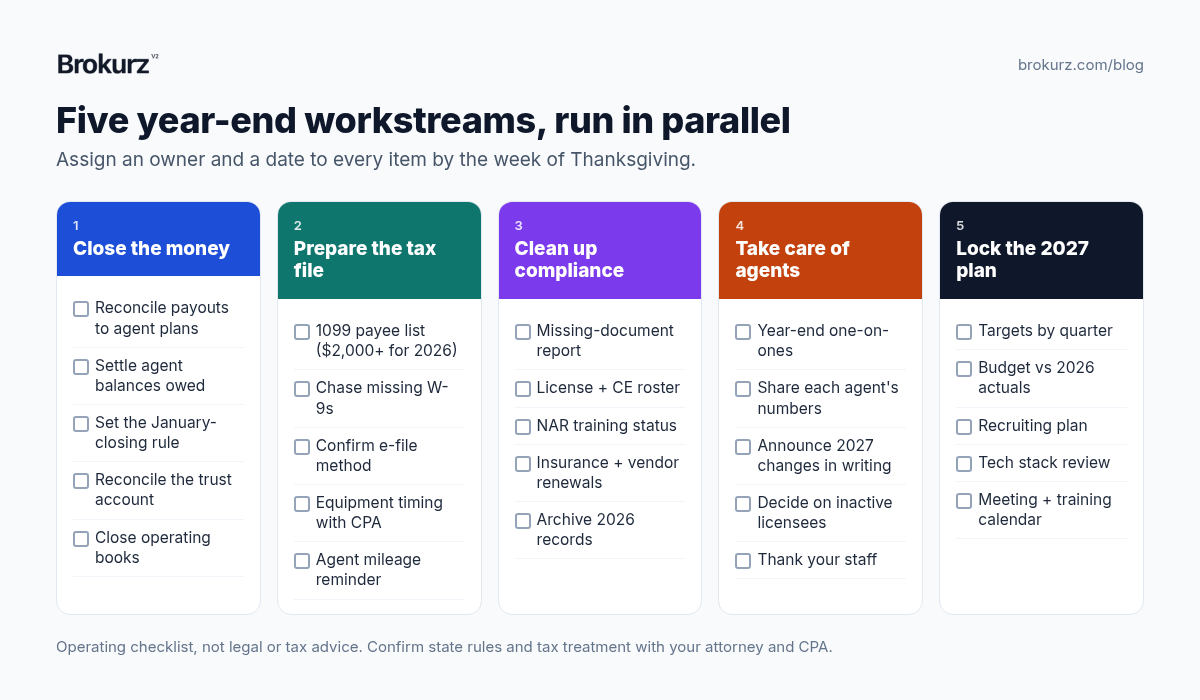
Here is the thesis of this guide. A clean year-end comes down to five workstreams that run in parallel through the last six weeks of the year: close the money, prepare the tax file, clean up compliance records, take care of your people, and lock the 2027 plan. If each workstream has an owner and a deadline by the week of Thanksgiving, December becomes routine work rather than a scramble.
This guide is for broker-owners, managing brokers, office managers, and the bookkeepers and transaction coordinators who support them. It is written for brokerages of any size, from a five-agent independent shop to a multi-office firm.
Scope note: this is an operating checklist, not legal, tax, or accounting advice. Dates and dollar figures below come from the IRS, the National Association of REALTORS® (NAR), and Florida administrative rules listed in the Sources section, and they can change. Real estate license law differs by state. Check your state's rules and talk with a CPA and an attorney before acting on anything here.
How to use this real estate brokerage year-end checklist
The year-end calendar: dates that do not move
Workstream 1: Close the money
Workstream 2: Prepare the tax file
Workstream 3: Clean up compliance and records
Workstream 4: Take care of your agents and staff
Workstream 5: Lock the 2027 plan
The master year-end checklist (printable table)
Year-end readiness scorecard
Mistakes that cost brokerages the most in January
How Brokurz fits
FAQ
How to use this real estate brokerage year-end checklist
Most year-end lists fail for one reason: they are a pile of tasks with no owner and no date. The fix is simple. Before you touch a single item, assign every line in the master table below to a named person (broker-owner, office manager, bookkeeper, transaction coordinator, or team lead) and give it a due date. Then hold a 20-minute check-in once a week through the end of January.
Three rules make the list work:
Run the workstreams in parallel, not in sequence. The tax file depends on clean money records, but compliance cleanup and agent reviews do not need to wait for either.
Close the data first, then the decisions. You cannot set 2027 commission plans or budgets until you have trustworthy 2026 numbers per agent.
Write down what you decided. Every change for 2027 (fees, splits, caps, policies) should exist as a dated document that agents can see, not as something you said at the holiday party.
The year-end calendar: dates that do not move
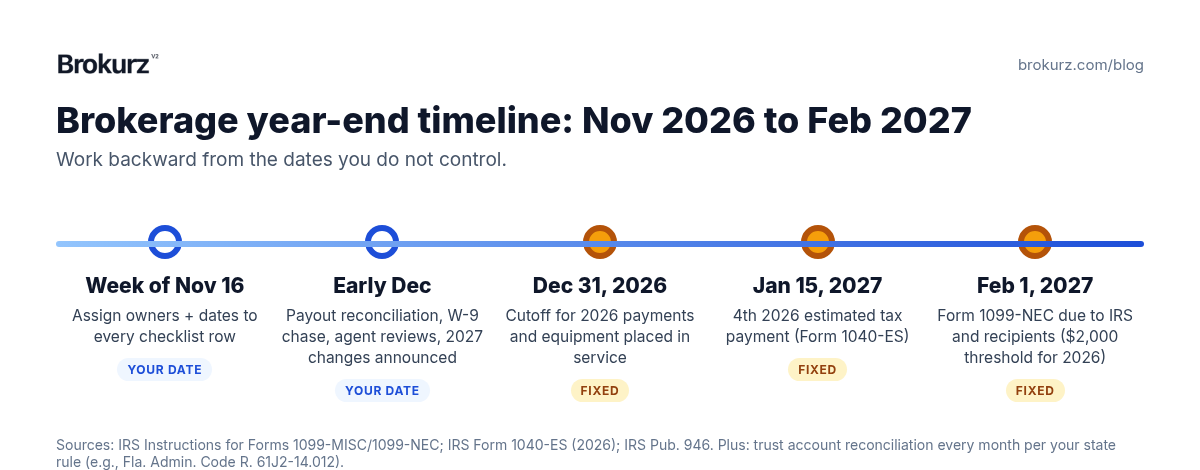
Most of year-end is self-imposed deadlines. A handful of dates are set by someone else. Put these on the office calendar first and work backward.
Date
What happens
Source
Every month (including December)
Florida brokers holding escrow must prepare, sign, and date a written monthly reconciliation of trust accounts
Fla. Admin. Code R. 61J2-14.012(2)
December 31, 2026
Last day for a payment to count toward 2026 totals for 1099 purposes; last day to place equipment in service for a 2026 deduction on a calendar-year return
IRS, Form 1099 guidance; IRS Pub. 946
December 31, 2027
End of the current NAR Code of Ethics and Fair Housing training cycle (started January 1, 2025)
NAR
January 15, 2027
Fourth 2026 estimated tax payment due for individuals (covers income from September 1 to December 31, 2026)
IRS Form 1040-ES (2026)
February 1, 2027
Form 1099-NEC due to the IRS and to recipients. The statutory date is January 31, which falls on a Sunday in 2027, so it moves to the next business day
IRS Instructions for Forms 1099-MISC and 1099-NEC
Two notes on that table. First, the Florida reconciliation rule is a good model even if you are licensed elsewhere, because most states require some form of regular trust account reconciliation; check your own commission's rule. Second, the NAR training deadline is a year away, which is exactly why you should check it now. Per NAR, members who miss the cycle are suspended for the following January and February and terminated on March 1 if still out of compliance. Finding the gaps in December 2026 gives your agents a full year to fix them.
Workstream 1: Close the money
The money workstream is the foundation. Every other decision (tax filings, agent conversations, 2027 budgets) depends on 2026 numbers you trust.
Reconcile commission payouts by agent
Pull every closed transaction for the year and tie it to what each agent was actually paid. You are looking for:
Deals that closed but were never paid out, or were paid twice.
Split or cap calculations that do not match the agent's written plan.
Referral fees paid out or received that are not tied to a transaction record.
Agent-owed balances (desk fees, transaction fees, E&O fees, marketing charges) that were never collected or never netted from a payout.
For each agent, the end product is one line: gross commission income, brokerage share, agent share, fees charged, fees collected, and balance owed in either direction. If your commission plans include caps, add one more column: where the agent stands against the cap, and when the cap year resets. The commission plan mechanics behind those columns are covered in real estate agent commission plans.
Decide how to treat January closings
Some deals will be scheduled to close in the first week of January. Decide now, in writing, which year's cap, split, and fee schedule applies (usually the closing date or the funding date) and tell agents before those deals close. Ambiguity here is one of the most common sources of payout disputes.
Reconcile the trust account
If your brokerage holds earnest money or other escrow funds, do not let the December reconciliation slip because the office is busy. Florida's rule is a useful benchmark for what a complete reconciliation looks like. Under Rule 61J2-14.012(2), the monthly statement must include the date the reconciliation was done, the date used to reconcile, the bank and account names and numbers, account balances, deposits in transit, outstanding checks by date and check number, and an itemized list of the broker's trust liability. The broker must review, sign, and date it. Under 61J2-14.012(3), any difference between trust liability and the bank balance needs a written explanation and the corrective action taken. Florida Realtors notes that an accountant can prepare the statement, but the broker still signs it and remains responsible for the funds.
Close the operating books
Work with your bookkeeper to reconcile operating bank and card accounts through December 31, clear uncategorized transactions, and confirm that brokerage revenue in the books matches the commission report from the step above. If those two numbers do not agree, find out why before you file anything.
Workstream 2: Prepare the tax file
This workstream gets your CPA what they need and keeps you inside IRS deadlines. Again, this is not tax advice. Use it to organize the conversation with your tax professional.
Get 1099-NEC ready now, not in January
For payments made in 2026, the IRS reporting threshold for Form 1099-NEC is $2,000, up from $600 for payments made before 2026, per the IRS page "Am I required to file a Form 1099 or other information return?" That same page notes you must also file Form 1099-NEC for anyone you backup-withheld on, regardless of the amount, and that payments to incorporated businesses are generally not reportable unless they are for medical or legal services. It also states that anyone with 10 or more information returns must file them electronically, and that the IRS offers free filing through the Information Returns Intake System (IRIS).
The practical year-end steps:
Run a payee list: everyone the brokerage paid for services in 2026 (agents, referral partners who are not brokerages, photographers, contract TCs, contractors).
Total each payee and flag anyone at or above $2,000.
Confirm a current W-9 is on file for each flagged payee, and chase missing ones in December while agents still answer emails quickly.
If you will file 10 or more returns, confirm your e-file method well before February 1. The IRS notes that a Transmitter Control Code for e-filing can take up to 45 days to process.
If the brokerage is planning to buy computers, phones, furniture, or other equipment, timing matters. Per IRS Publication 946, for tax years beginning in 2026 the maximum Section 179 expense deduction is $2,560,000, reduced by the amount by which qualifying property placed in service during the year exceeds $4,090,000. Separately, IRS Topic 704 explains that the special depreciation allowance is 100% for qualified property acquired and placed in service after January 19, 2025. The key word in both rules is "placed in service": equipment sitting in a box on December 31 is not the same as equipment in use. Your CPA can tell you which approach fits your situation and whether it makes sense at all.
Remind agents about mileage logs
Your agents are generally independent contractors who track their own deductions, but a short reminder from the brokerage is a real service. The IRS standard mileage rate for business use was 72.5 cents per mile for January 1 to June 30, 2026, and 76 cents per mile for July 1 to December 31, 2026, after a midyear increase (IRS, "Standard mileage rates"). Agents who keep a single annual total instead of dated logs will have a harder time applying two different rates. Suggest they close out their logs in December.
Plan the owner's fourth estimated payment
If the brokerage is a pass-through entity, the owner's personal estimated taxes matter too. The 2026 Form 1040-ES lists January 15, 2027 as the fourth payment date, and notes that the January payment is not required if the 2026 return is filed by February 1, 2027 with the full balance paid. Agents who are paid on a 1099 face the same date, which is another useful item for your year-end agent email.
Workstream 3: Clean up compliance and records
Compliance cleanup is the least urgent-feeling workstream and the one that hurts most if skipped.
Audit open and closed transaction files
Run a missing-document report on every file that closed in 2026 and every file still open. Typical gaps: unsigned disclosures, missing broker review sign-off, missing agency or brokerage relationship disclosures, and missing earnest money receipts. Fix what can be fixed, document what cannot, and note patterns by agent for coaching. The full list of what a file review should cover is in the compliance audit checklist.
Build a license and training roster
Make a single roster with every licensee's license number, expiration date, continuing education status, and, for REALTOR® members, NAR training status. NAR requires at least 2 hours and 30 minutes of Code of Ethics training per cycle, and the same NAR page says members must also complete Fair Housing / Anti-Bias training every three years in step with the ethics cycle. The current cycle for both runs January 1, 2025 to December 31, 2027. Flag anyone whose state license renews in the first quarter of 2027 so renewals do not lapse mid-transaction.
Check insurance renewals and vendor contracts
List every policy (errors and omissions, general liability, cyber, workers' compensation if you have employees) and every software contract with its renewal date and auto-renew terms. Year-end is when many vendor contracts renew, and a renewal you did not plan for is a budget surprise. Our guide to brokerage insurance covers what each policy is for.
Archive and retain
Confirm that 2026 transaction files, trust account records, and reconciliations are stored where you can find them during an audit. Florida's rule requires brokers to preserve deposit slips and bank statements and make them available for inspection; your state will have its own retention period, so confirm it with your commission.
Workstream 4: Take care of your agents and staff
Your agents decide in December and January whether to stay. Year-end is your best retention window.
Hold year-end agent reviews
Give every agent a short one-on-one with their own numbers: units closed, volume, gross commission income, where they stand against any cap, and fees paid. Ask what they want for 2027 and what got in their way in 2026. Agents who hear their numbers from the broker, accurately, trust the brokerage more than agents who piece it together from bank deposits. See how to retain real estate agents for the conversation framework.
Announce 2027 plan changes properly
If you are changing splits, caps, desk fees, transaction fees, or technology fees for 2027, check the notice terms in your independent contractor agreements, then announce changes in writing with an effective date. Give agents enough lead time to plan. Surprise fee changes in January are one of the most avoidable reasons agents start interviewing elsewhere.
Offboard inactive licensees
Agents who have not closed or had any activity all year still create risk and cost. Decide whether to keep, coach, or release them, and if releasing, follow your state's process for transferring or releasing a license and collect any brokerage property or account access.
Thank your staff
Office managers, TCs, and admins carry December. Recognize them. It costs little, and it is the cheapest retention tool you have.
Workstream 5: Lock the 2027 plan
With clean 2026 numbers in hand, the plan almost writes itself.
Targets: agent count, transactions, volume, and company dollar (what the brokerage keeps after agent commissions) for 2027, by quarter.
Budget: fixed costs (rent, software, insurance, staff) and variable costs (marketing, recruiting, events). Compare to 2026 actuals.
Recruiting plan: how many agents you need to hit the targets after expected attrition, and where they will come from.
Technology review: list every tool, what it costs per year, and what it does. Many brokerages find overlapping tools during this step; our guide to cutting tech stack sprawl walks through the audit.
Calendar: sales meetings, training, and compliance reviews scheduled for the whole year.
Copy this into a shared document, assign an owner to every row, and review it weekly.
#
Task
Workstream
Suggested owner
Target date
1
Assign owners and dates to every row of this list
All
Broker-owner
Week of Nov 16
2
Pull all 2026 closed transactions and payouts by agent
Money
Bookkeeper
Dec 4
3
Reconcile splits, caps, and fees to each agent's written plan
Money
Office manager
Dec 11
4
Collect or settle agent balances owed
Money
Office manager
Dec 31
5
Decide and announce which year January closings count toward
Money
Broker-owner
Dec 4
6
Complete, sign, and date the December trust account reconciliation
Money
Broker
Per state rule
7
Close operating books through Dec 31; tie revenue to commission report
Money
Bookkeeper
Jan 15
8
Build 1099 payee list and flag payees at $2,000 or more
Tax
Bookkeeper
Dec 11
9
Chase missing W-9s
Tax
Office manager
Dec 18
10
Confirm e-file method if filing 10+ information returns
Tax
Bookkeeper
Dec 18
11
Review equipment purchases and timing with CPA
Tax
Broker-owner
Dec 11
12
Send agents the mileage-log and estimated-tax reminder
Tax
Office manager
Dec 4
13
File and furnish Form 1099-NEC
Tax
Bookkeeper
Feb 1, 2027
14
Run missing-document report on 2026 transaction files
Compliance
TC / compliance
Dec 18
15
Build license, CE, and NAR training roster
Compliance
Office manager
Dec 18
16
List insurance and software renewals with dates and terms
Compliance
Office manager
Dec 11
17
Archive 2026 files and reconciliations per retention rules
Compliance
TC / compliance
Jan 29
18
Hold year-end reviews with every agent
People
Broker / team leads
Dec 18
19
Announce 2027 commission and fee changes in writing
People
Broker-owner
Dec 1
20
Decide on inactive licensees
People
Broker
Dec 18
21
Set 2027 targets and budget
Plan
Broker-owner
Jan 8
22
Audit the tech stack and renewal dates
Plan
Office manager
Dec 31
23
Publish the 2027 meeting and training calendar
Plan
Broker
Jan 8
The dates are suggestions for a calendar-year brokerage. The only fixed dates in the table are the IRS deadline in row 13 and your state's trust account rule in row 6.
Year-end readiness scorecard
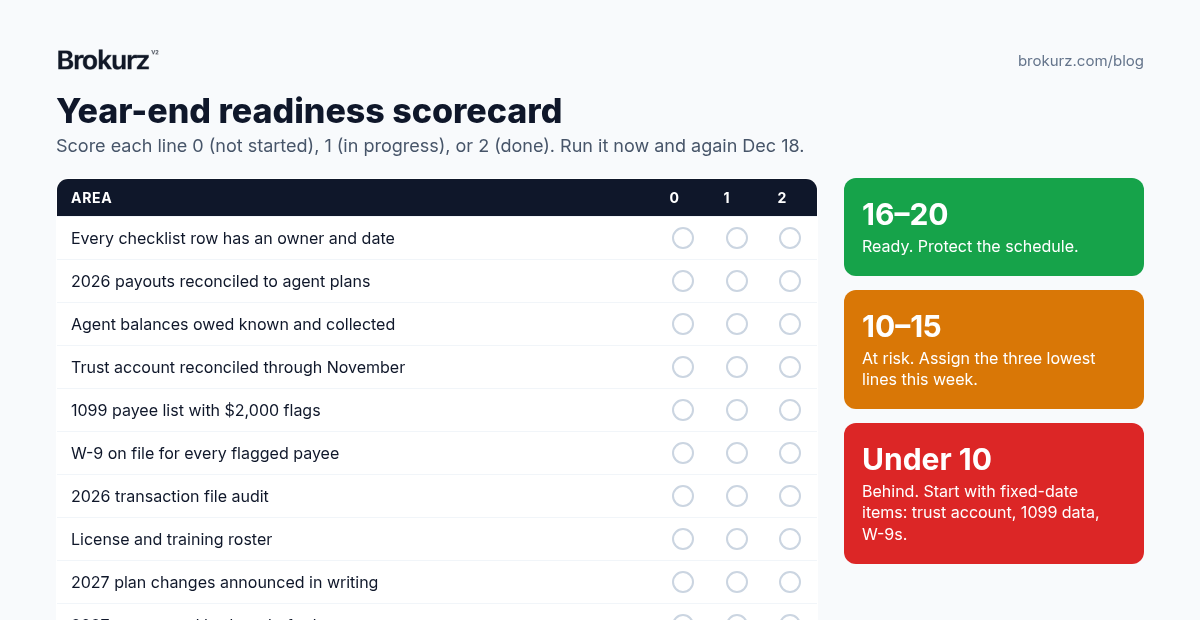
Score each line 0 (not started), 1 (in progress), or 2 (done). Run it the week of Thanksgiving and again on December 18.
Area
0
1
2
Every checklist row has an owner and date
No
Some
All
2026 payouts reconciled to agent plans
Not started
Partly
Done
Agent balances owed known and being collected
Unknown
Known
Settled
Trust account reconciled through November
No
Behind
Current
1099 payee list with $2,000 flags
No
Draft
Final
W-9 on file for every flagged payee
Many missing
A few missing
All
Transaction file audit for 2026
Not started
Partly
Done
License and training roster
None
Partial
Complete
2027 plan changes announced in writing
Not decided
Decided
Announced
2027 targets and budget drafted
No
Draft
Approved
16 to 20: you are ready; protect the schedule. 10 to 15: at risk; pick the three lowest lines and assign them this week. Under 10: behind; focus on the fixed-date items first (trust account, 1099 data, W-9s), then the rest.
Mistakes that cost brokerages the most in January
Treating year-end as a January project. The W-9s, payout reconciliations, and file audits are far easier to finish while agents are still responsive in early December.
Reconciling the bank but not the trust liability. A trust account reconciliation that only matches the bank statement to the checkbook misses the point. The Florida rule, for example, compares the reconciled balance with an itemized list of what the broker owes to whom.
Using last year's 1099 threshold. With the threshold at $2,000 for 2026 payments, copying last year's payee list will produce the wrong set of forms.
Announcing fee changes after January 1. Agents plan their year in December. Changes that land in January feel like a bait-and-switch, even when they are reasonable.
Forgetting the January closing rule. If the agreement does not say which year a January closing counts toward for caps and splits, expect a dispute.
Buying equipment on December 31 and assuming it counts. Deductions depend on when property is placed in service, and on your CPA's advice, not on the receipt date alone.
Ignoring the training cycle because the deadline is in 2027. A roster built now turns a December 2027 crisis into a routine reminder.
Building the 2027 budget on unreconciled numbers. If the commission report and the books disagree, the budget inherits the error.
How Brokurz fits
Brokurz is the AI operating system for real estate: transactions, compliance, commissions, CRM, back office, website, and recruiting in one place. For year-end, that matters because most of this checklist is a data problem. When transaction files, commission payouts, agent records, and back-office data live in one system, the per-agent totals, missing-document reports, and payee lists come from the same records that ran the business all year, instead of being rebuilt from spreadsheets, bank exports, and email threads in December. That leaves your team time for the parts that need judgment: agent conversations and the 2027 plan.
Lock in today's rate before December 1. New customers who sign up by November 30 keep today's price; prices go up December 1, and existing customers keep their rate. Sign up for Brokurz or book a demo to see transactions, commissions, and back office run in one system before you close out 2026.
FAQ
What should be on a real estate brokerage year-end checklist?
Five workstreams: close the money (payout reconciliation, agent balances, trust account), prepare the tax file (1099 payee list, W-9s, equipment timing, estimated payments), clean up compliance (file audit, license and training roster, insurance and vendor renewals, archiving), take care of people (agent reviews, written 2027 plan changes, inactive licensees), and lock the 2027 plan (targets, budget, recruiting, technology, calendar).
When should a brokerage start its year-end process?
Mid-November is a practical start for a calendar-year brokerage. That leaves about six weeks before December 31 for the items that depend on 2026 activity, and it puts W-9 collection and agent reviews in early December, before the holidays slow responses down.
What is the 1099-NEC deadline for 2026 payments?
Per the IRS instructions, Form 1099-NEC is due on or before January 31, and a due date that falls on a Saturday, Sunday, or legal holiday moves to the next business day. January 31, 2027 is a Sunday, so the deadline for 2026 forms is February 1, 2027. The reporting threshold for payments made in 2026 is $2,000.
Do brokerages have to reconcile trust accounts at year-end?
Most states require regular trust account reconciliation, and many require it monthly, so December is not special. It is just easy to skip. In Florida, Rule 61J2-14.012 requires a written monthly reconciliation comparing the broker's total trust liability with the reconciled bank balances, signed and dated by the broker. Check your own state's rule.
When does the current NAR Code of Ethics training cycle end?
NAR's current cycle runs from January 1, 2025 to December 31, 2027. Members must complete at least 2 hours and 30 minutes of ethics training in the cycle, and Fair Housing / Anti-Bias training follows the same three-year timeline. NAR states that members who miss the deadline are suspended for January and February and terminated on March 1 if still out of compliance.
What mileage rate applies for 2026?
The IRS business standard mileage rate was 72.5 cents per mile from January 1 to June 30, 2026, and 76 cents per mile from July 1 to December 31, 2026. Agents should keep dated logs so each trip can be matched to the right rate.
Should a brokerage buy equipment before December 31 for the tax deduction?
Only after talking with your CPA. IRS Publication 946 sets the 2026 Section 179 limit at $2,560,000, and the IRS describes a 100% special depreciation allowance for qualified property acquired and placed in service after January 19, 2025. But deductions depend on when property is placed in service, your business income, and your overall tax picture, so buy what the business needs rather than buying for the deduction.
How should brokerages communicate 2027 commission changes?
In writing, with an effective date, and before the new year. Check the notice terms in your independent contractor agreements first, then pair the announcement with each agent's 2026 numbers in a one-on-one review so the change comes with context.