Revenue Share Brokerages Explained: How the Model Works
Growth
Revenue Share Brokerages Explained: How the Model Works and What to Ask
Revenue share brokerages pay agents a slice of company revenue when agents they sponsor close deals. Here is where the money comes from, how tiers and producing-agent rules work, published eXp, Real and Fathom terms, and what to ask before you join.
Revenue share is the most talked-about, and most misunderstood, compensation idea in residential real estate. A revenue share brokerage pays agents a slice of the company's revenue when agents they sponsor close deals. Supporters call it a way to build income beyond your own closings. Skeptics say most agents will never earn much from it. Both can be true at the same time, and the only way to know which applies to you is to read the plan itself.
This guide explains how a revenue share brokerage works, where the money actually comes from, how tiers and "producing agent" rules decide who gets paid, and the questions agents and broker-owners should ask before signing. It is written for two readers: agents comparing a revenue share offer against a traditional or 100% commission brokerage, and broker-owners deciding how to compete with (or whether to copy) the model. Every program detail below comes from the brokerages' own public pages, linked in Sources. Plans change, so confirm the current terms in the independent contractor agreement before you rely on any number here.
In this guide:
What revenue share means, in one paragraph
Where revenue share money comes from (company dollar)
How tiers, levels, and unlock rules work
Published terms at eXp Realty, Real, and Fathom, side by side
A worked example with real numbers from a brokerage's own help center
A revenue share brokerage is a real estate company that shares part of the revenue it keeps from agent commissions with the agents who sponsored (recruited) those agents. If you sponsor an agent, and that agent closes a deal and pays the brokerage its split, the brokerage passes a defined portion of that split to you. If the agent you sponsored sponsors someone else, you may also earn on that second agent's deals, depending on how many "tiers" or "levels" the plan has and whether you have unlocked them.
eXp Realty describes revenue share as "a percentage of revenue that agents earn for attracting agents who are generating revenue for the company." eXp's founder, quoted in a May 2024 company press release, said eXp first created the revenue share model in 2009. Real (The Real Brokerage) and Fathom Realty run their own versions, and the rules differ in ways that matter.
Two points are worth stating plainly up front:
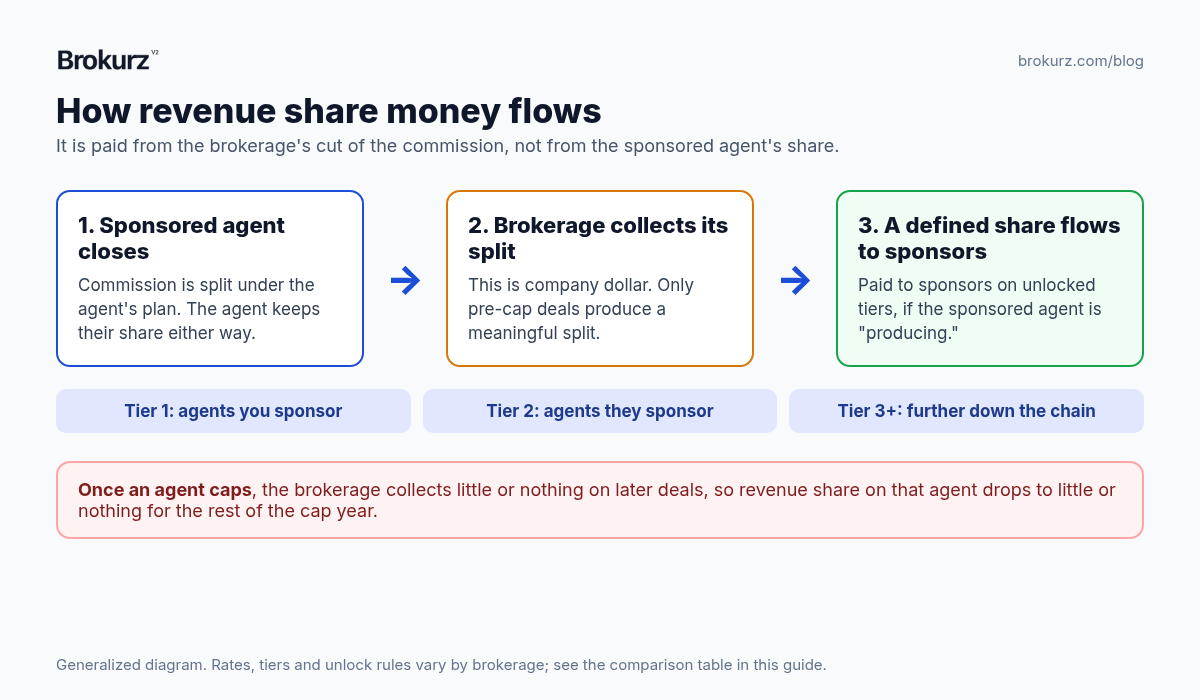
Revenue share is paid out of the brokerage's cut, not the sponsored agent's. The sponsored agent pays the same split whether or not they have a sponsor. Real's help center says revenue share "only applies if you are paying your split to Real... it's the revenue Real earns that is shared with our agents."
It stops when the money stops. Every plan reviewed here pays only on transactions from agents who are currently producing, and only on revenue the brokerage collects before the agent caps.
Where revenue share money comes from: company dollar
Every revenue share plan is a split of company dollar, the commission revenue the brokerage keeps after paying its agents. eXp's income page says the program redistributes 50% of the company's split (the 20% portion of its 80/20 commission split). eXp's May 2024 press release says the company is "committed to sharing 50 percent of the company dollar with the agents who help the company grow."
That has a direct consequence: once an agent caps, there is usually little or no company dollar left on their later deals, so there is little or no revenue share either. Fathom's FAQ says it outright: "Only pre-cap revenue is included in Revenue Share calculations." So the maximum revenue share any one sponsored agent can generate in a year is bounded by that agent's cap.
Why this matters for agents
If the agents you sponsor rarely reach the cap, the brokerage collects their split on every deal, and the revenue share on them can be steady. If they are big producers who cap early in the year, the revenue share on them ends early too. Revenue share rewards sponsoring agents who keep producing, not just agents who join.
Why this matters for broker-owners
A brokerage that commits half its company dollar to revenue share has half as much left for staff, technology, marketing, and profit. The model only works if the firm runs on very low overhead per agent, which is why the companies that use it are mostly cloud-based or have lean office footprints. See our breakdown of brokerage profit margins and break-even agent counts for the math on the other side of that trade.
How tiers, levels, and unlock rules work
Revenue share plans organize your network into tiers (Real and eXp) or levels (Fathom):
Tier or Level 1: agents you personally sponsor.
Tier 2: agents sponsored by your Tier 1 agents.
Tier 3 and beyond: each step further down the sponsorship chain.
Three kinds of rules decide what you actually receive:
Payout rate per tier. For example, Real pays 5% of the sponsored agent's GCI at Tier 1, then 4%, 3%, 2%, and 1% for Tiers 2 through 5. Fathom pays 20% of the pre-cap split at each of its five levels.
Unlock requirements. Deeper tiers usually require a minimum number of producing Tier 1 agents. At Real, Tier 2 requires at least 5 producing Tier 1 agents, Tier 3 requires 15, Tier 4 requires 20, and Tier 5 requires 25 (with two alternative unlock paths, covered below). At Fathom, Levels 1 and 2 unlock automatically, and Levels 3, 4, and 5 require 4, 8, and 12 agents.
"Producing" or "qualifying" status. Sponsored agents only count, and only generate revenue share, while they meet a production test. eXp counts a front-line qualifying agent (FLQA) only if they produced at least $5,000 in GCI from qualifying transactions over the past six months. Fathom counts a Producing Agent only if they closed at least one sale with Fathom in the prior six months. Real says agents "must be producing" to count toward its Tier 1 unlock path.
The practical effect: your revenue share can go down even when nobody leaves. Real's help center gives an example where one of five sponsored agents goes six months without a closing, the sponsor drops to four producing agents, and Tier 2 locks.
Published terms side by side: eXp Realty, Real, and Fathom
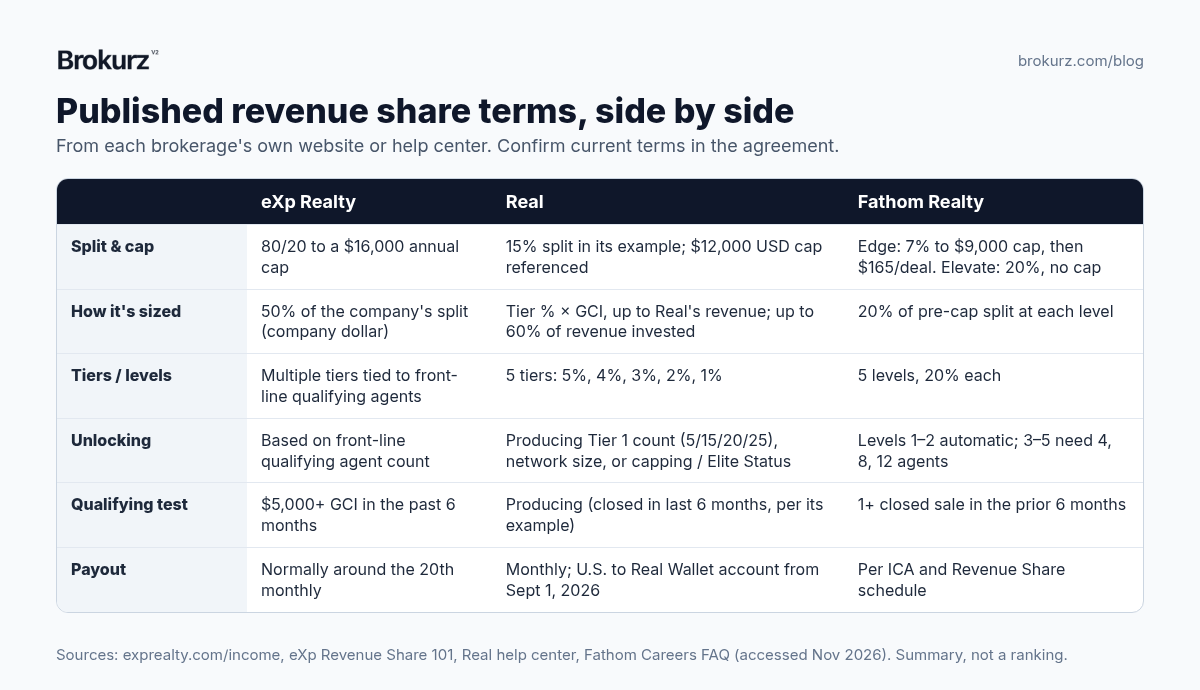
The table below summarizes what each company publishes on its own site or help center as of this writing. It is a fair-reading summary, not a ranking. Each company structures its plan to reward a different behavior, and each has more detail (and exceptions) in its agreement.
eXp Realty
Real (The Real Brokerage)
Fathom Realty
Agent split and cap (published)
80/20 until a $16,000 annual cap
Example on its help center uses a 15% split; Producer Path references a $12,000 USD cap
Edge: 7% split to a $9,000 cap, then $165 per transaction. Elevate: 20% split, no cap
How revenue share is sized
Redistributes 50% of the company's split (company dollar)
Tier % × sponsored agent's GCI, up to the revenue Real collects; Real says it invests up to 60% of its revenue in the program
20% of the company's pre-cap split at each unlocked level
Tiers or levels
Multiple tiers tied to front-line qualifying agent counts
5 tiers: 5%, 4%, 3%, 2%, 1%
5 levels, 20% each
Unlocking deeper tiers
Based on number of front-line qualifying agents
Three paths: producing Tier 1 count (5/15/20/25), network size (750+, 1,000+, 1,500+), or personal production (capping unlocks up to Tier 3; Elite Status unlocks up to Tier 5)
Levels 1–2 automatic; Levels 3–5 need 4, 8, and 12 agents
Who counts as qualifying
$5,000+ GCI from qualifying transactions in the past 6 months
Must be producing (closed a transaction in the last 6 months, per its example)
At least one closed sale with Fathom in the prior 6 months
When paid
Normally around the 20th of each month
Monthly adjustment; from Sept 1, 2026, U.S. payouts go only to a Real Wallet business checking account
Per the ICA and Revenue Share schedule
A few fair observations:
eXp publishes the most income data of the three (see below), and its 50% company-dollar commitment is simple to explain.
Real gives agents three different ways to unlock deeper tiers, so a strong personal producer can unlock tiers without recruiting large numbers of agents.
Fathom pays the same 20% at every level and unlocks the first two levels automatically. Because Edge company dollar is capped at $9,000 per agent per year, 20% of that cap works out to a maximum of $1,800 per qualifying Edge agent per year in revenue share.
A worked example, using one brokerage's published numbers
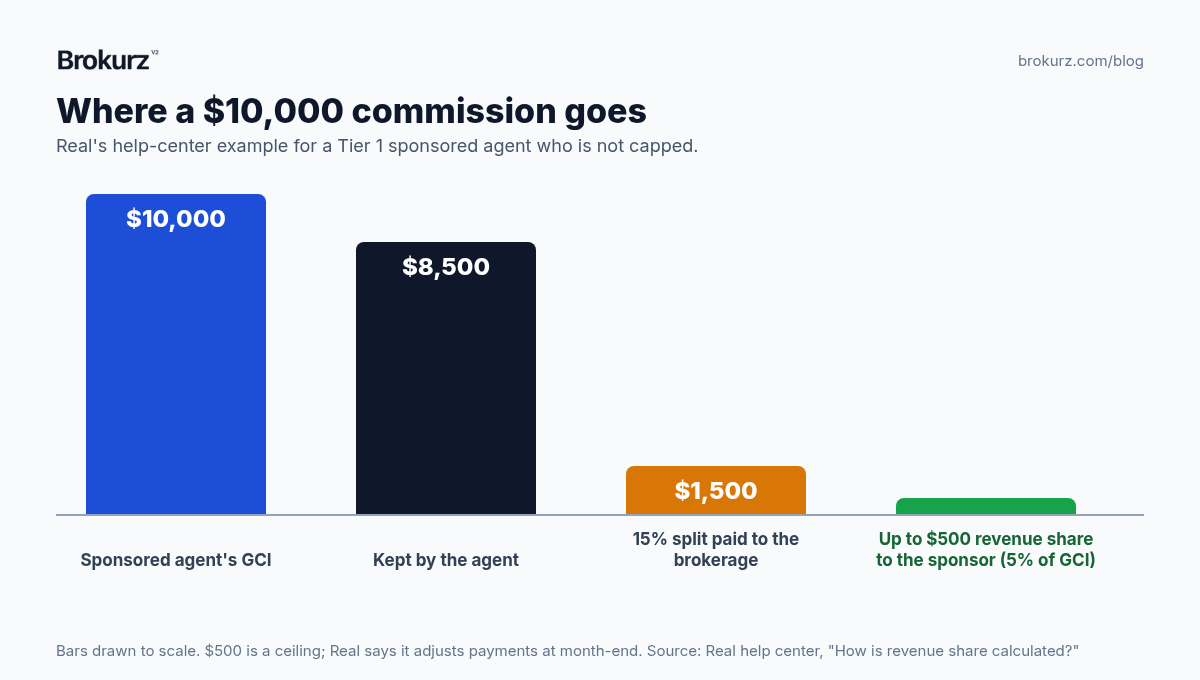
Real's help center walks through a single transaction. Here it is, unchanged:
Step
Amount
Sponsored (Tier 1) agent's GCI on the deal
$10,000
Agent is not capped and pays a 15% split to Real
$1,500 to Real
Tier 1 revenue share rate
5% of GCI
Maximum potential revenue share to the sponsor
$500
Real adds that it "invests up to 60% of its Revenue into the revenue share program and will adjust revenue share payments at the end of the month accordingly." So $500 is the ceiling, not a guarantee.
Now scale it honestly. If you sponsored five agents and each closed $10,000 in GCI before capping, the same math gives a ceiling of $2,500 in Tier 1 revenue share for those deals. That is real money, but it is far from the "passive income" claims sometimes made in recruiting posts. Larger numbers come from large, deep, consistently producing networks, built over years.
What income disclosures actually show
eXp publishes an annual income disclosure on its website. For the 2025 performance year, it reports gross compensation that includes commissions, revenue share, and equity awards:
The median income across all registered agents was $4,985.
The median for active agents was $13,463.
The median for active agents with 1+ year of tenure was $22,175.
The Elite group (earning $1 million to $10 million) was 0.39% of active agents, and eXp says that level typically requires a long-term commitment of 8+ years.
eXp's May 2024 press release also states that the company shared over $197 million in revenue share with agents in 2023.
Two takeaways. First, the median figures include commissions, so they say more about agent production than about revenue share alone. Second, eXp itself frames large revenue share income as rare and long-term. That is useful, honest context for any agent being recruited with revenue share as the headline. If a brokerage does not publish an income disclosure, ask for one.
15 questions to ask before joining a revenue share brokerage
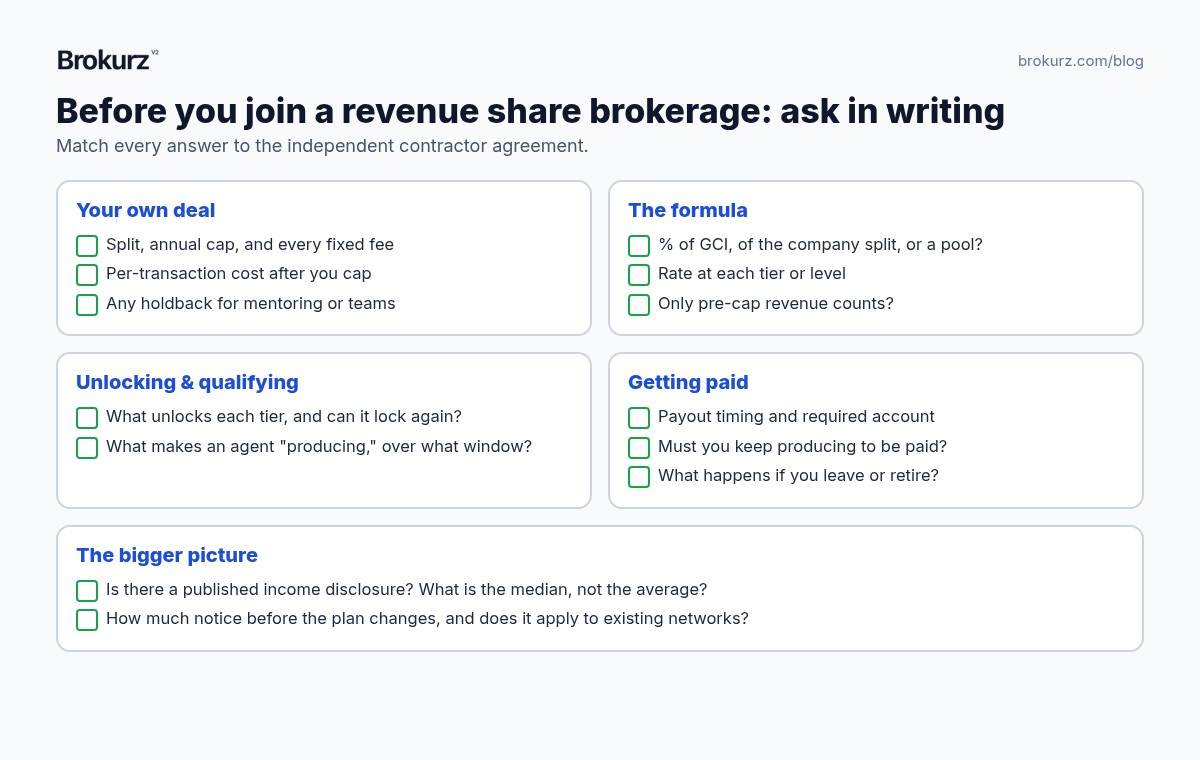
Use this as an interview checklist. Ask for answers in writing, and match them to the independent contractor agreement (our independent contractor agreement guide covers what that document should contain).
The deal you get on your own production
What is my split, my annual cap, and every fixed fee (startup, monthly, per-transaction, E&O)?
After I cap, what do I pay per transaction?
Is any of my commission held back for mentoring, training, or a team?
How revenue share is calculated
Is revenue share a percentage of GCI, of the company's split, or of a pool? Is it capped or adjusted at month-end?
How many tiers or levels are there, and what is the rate at each?
Exactly what unlocks each tier, and can a tier lock again?
What makes a sponsored agent "producing" or "qualifying," and over what window?
Does revenue share apply only to pre-cap revenue?
Getting paid
When is revenue share paid, and into what account?
Do I need to be producing myself to keep receiving it?
What happens to my revenue share if I leave, retire, or become inactive? Is any of it transferable or payable to an estate, and where is that written?
The bigger picture
Is there a published income disclosure, and what is the median, not the average?
What support, tools, and broker oversight do I get for my split?
Are there rules against paying people to name you as their sponsor?
If the plan changes, how much notice do agents get, and can changes apply to existing networks?
A quick scorecard
Score each 0–2 (0 = unclear or unwritten, 1 = verbal answer, 2 = written in the agreement or official help center):
Area
0
1
2
Split, cap, and fees
Revenue share formula
Tier unlock and lock rules
Producing-agent definition
Payout timing and account
Exit, retirement, and transfer terms
Income disclosure
Anything scoring 0 is a question to resolve before you move your license.
Common mistakes agents make with revenue share
Judging the plan by the top earners. Look at medians and at how many agents are in each income band.
Ignoring the producing-agent rule. A large network of agents who rarely close generates little.
Forgetting the cap ceiling. Revenue share on any one agent is limited by that agent's pre-cap split.
Choosing a brokerage for revenue share and ignoring the core deal. For most agents, the split, cap, fees, support, and lead flow matter more to annual income.
Not reading the exit terms. Ask how revenue share is handled if you leave, and get the answer in the agreement.
Sponsoring agents who are a poor fit. Their production, and your reputation, depend on them succeeding.
What broker-owners should take from the revenue share model
Most brokerages will never run a multi-tier revenue share plan, and they do not need to. But the model holds three lessons for any broker-owner competing for agents:
Agents respond to transparency. The revenue share companies publish their splits, caps, fees, and payout rules in public help centers. Agents now expect that clarity from every brokerage. If your commission plan lives in a PDF nobody can find, fix that first.
Rewarding referrals of agents works. You can offer a simple, one-time agent referral bonus, or a capped attraction bonus, without a multi-level structure. Check your state's rules on compensation to licensees and get your attorney to review the plan.
Your company dollar has to fund your value. If you are not sharing company dollar with agents, show them what it pays for: transaction coordination, compliance review, marketing, training, technology, and a broker who answers the phone. Our guides on recruiting agents in 2026 and 100% commission vs traditional splits go deeper on how to make that case.
This guide is general information, not legal, tax, or financial advice. Compensation to licensees is regulated at the state level; check with your state real estate commission and an attorney before designing or joining any plan.
How Brokurz helps brokerages run any compensation model
Brokurz is the AI operating system for real estate: transactions, compliance, commissions, CRM, back office, website, and recruiting in one place. Whatever plan you run, from traditional splits to caps and per-transaction fees, the work of tracking each agent's split, cap progress, fees, and payouts sits alongside the transactions and compliance files it depends on, so broker-owners can see company dollar and agent production without stitching spreadsheets together. And when you are recruiting, your plan details and your agent pipeline live in the same system.
Lock in today's rate before December 1. New customers who sign up by November 30 keep today's price; prices go up December 1, and existing customers keep their rate.
A brokerage that shares part of the revenue it keeps from agent commissions with the agents who sponsored those agents. You earn when agents you sponsored (and, in tiered plans, agents they sponsored) close deals and pay the brokerage its split.
Does revenue share come out of the sponsored agent's commission?
No. In the plans reviewed here, revenue share is paid from the brokerage's share. Real's help center says it is "the revenue Real earns that is shared with our agents," and eXp says it redistributes part of its company dollar.
Is revenue share the same as an MLM?
Revenue share plans are multi-tier, which is why the comparison comes up. The key differences in the plans reviewed here are that payouts come from real estate commissions on closed transactions, not product purchases, and the plans publish no cost to participate (eXp lists $0). Judge any plan on its written terms and its income disclosure.
How much can you make from revenue share?
It depends on how many agents you sponsor, how much they produce before capping, and which tiers you unlock. Real's published example shows a $500 maximum on a $10,000 commission from a Tier 1 agent. eXp's 2025 disclosure shows a median of $22,175 in total compensation for active agents with more than a year of tenure, including commissions.
Do you keep revenue share if you stop selling?
It depends on the plan. Fathom says the sponsoring agent does not need to be a Producing Agent to receive revenue share if other eligibility rules are met. Other plans have their own rules. Ask, and get the answer in the agreement.
Does revenue share stop when an agent caps?
Generally, yes, for that agent's later deals in the cap year. Fathom states that only pre-cap revenue is included, and eXp's and Real's plans are sized from the brokerage's split, which shrinks or ends once an agent caps.
Which brokerages offer revenue share?
eXp Realty, Real, and Fathom Realty all publish revenue share programs, and other brokerages offer their own versions. Compare the written terms, since tier rates, unlock rules, and producing-agent tests differ.
Should a traditional brokerage add revenue share?
Only if your economics support it. Sharing company dollar reduces what is left for staff, tools, and profit. Many brokerages get similar recruiting benefit from a simple agent referral bonus and a clearly published commission plan. Have an attorney review any plan for your state.
Sources
eXp Realty, Income and earnings disclosure (2025 performance data, fees, split and cap, revenue share basis): https://www.exprealty.com/income