Desk Fee Real Estate Brokerage: Pros, Cons, and the Math
Operations
Desk Fee Real Estate Brokerage: Pros, Cons, and the Math
A desk fee real estate brokerage charges agents a fixed monthly fee and lets them keep most of every commission. This guide covers what the fee includes, how it compares with splits and caps, published examples, and break-even math for both sides.
A desk fee real estate brokerage flips the usual deal. Instead of taking a percentage of every commission check, the brokerage charges agents a fixed fee, usually monthly, and lets them keep all or nearly all of what they earn. For a busy agent that can mean thousands of dollars a year. For a slow agent it can mean paying rent on a desk that produced nothing. For the broker-owner it means revenue that shows up on the first of the month instead of at closing, and a business that lives or dies on how many seats are filled.
This guide explains how the desk fee model works, what a desk fee usually covers, how it compares with splits, caps, and per-transaction fees, and the break-even math for both sides of the table. It is written for broker-owners deciding whether to offer a desk fee plan (or add one next to a split plan), and for agents comparing a desk fee offer against what they pay today. Fee figures for named brokerages come from their own public pages, linked in Sources. The worked examples are illustrative arithmetic, not industry benchmarks.
In this guide:
What a desk fee is, in plain terms
Where the model came from
What a desk fee covers, and what it often does not
Desk fee vs split vs cap vs transaction fee
Published fee-based plans, side by side
Break-even math for agents
Break-even math for broker-owners
How to set your desk fee
When the model works: a scorecard
Mistakes to avoid
FAQ
If you want the bigger picture first, read our guides to commission plans, splits, caps, and fees and company dollar. The desk fee model is easiest to judge once you know what your brokerage keeps today under a split.
How a desk fee real estate brokerage works
A desk fee is a fixed amount an agent pays the brokerage for the right to work under its license, brand, and supervision, whether or not the agent closes a deal that period. It is usually billed monthly. In return, the agent keeps a much larger share of each commission than under a traditional split, often 100% or close to it.
The name comes from the original idea: the agent was literally renting a desk in the broker's office. Today the "desk" may be a private office, a shared workstation, or no physical space at all. Bernice Ross, writing in Inman, describes desk fee agents being charged "based upon whether the agent maintains a desk in the office, uses a work station or works from home." That tiering is still a common way to price the model.
Three things make a desk fee different from other ways a brokerage gets paid:
It is fixed. The amount does not move with the agent's production. Ten closings or zero, the bill is the same.
It is paid in advance of results. The brokerage collects before the agent's deals close, so the agent carries the risk of a slow month.
It usually sits alongside other fees. Many desk fee plans also charge a per-transaction fee, an E&O fee, or a technology fee. The desk fee is rarely the whole cost.
Where the desk fee model came from
The model is most closely tied to RE/MAX. RE/MAX's own history page says Dave Liniger founded the company in Denver in January 1973 around a "maximum-commission model" for "full-time, serious professionals who would rather contribute collectively to office expenses than settle for a traditional commission split." A 2023 RealEstateNews article marking the company's 50th anniversary describes the founding idea directly: let agents keep 100% of their commissions, and in return have them pay a monthly desk fee.
The same article notes that the model has evolved. RE/MAX agents "no longer keep 100% of their commissions," the company's 95/5 split is among the highest in the industry, and RE/MAX "also offers more traditional split options for agents who don't want to pay a separate desk fee each month." That evolution is a useful lesson for broker-owners: even the brand that made the desk fee famous now offers agents a choice of plans.
What a desk fee usually covers (and what it often does not)
There is no standard desk fee package. What matters is what the fee buys compared with what the agent would otherwise pay for directly. Use this as a checklist when you design a plan or compare offers.
Often included in the desk fee:
The right to hang a license with the brokerage, plus broker supervision and compliance review
Office access: a private office, a shared workstation, or conference rooms only
Brand use: signs, business cards, and email on the brokerage domain
Core technology: transaction management, document storage, and sometimes a CRM
Training and onboarding
Often charged separately:
Per-transaction fees at closing
Errors and omissions (E&O) insurance
Franchise fees or royalties, where the brokerage is part of a franchise
Marketing: print, signs and riders, mailers, and websites
Lead programs and referral fees on company-generated leads
Ross's Inman example shows why the "separately" list matters. For an agent earning $100,000 in gross commission income on a desk fee plan, she lists $1,000 a month for management, shared office, and tech fees, $700 a month for a private office, a 6% franchise fee, and marketing and tool costs. In her scenario the agent's total comes to $36,288, netting $63,712, while a full-service agent on a 70/30 split who pays only E&O nets $69,400. Her point is not that desk fees are bad. It is that the headline split is meaningless until you add up every cost each side pays.
Desk fee vs split vs cap vs transaction fee
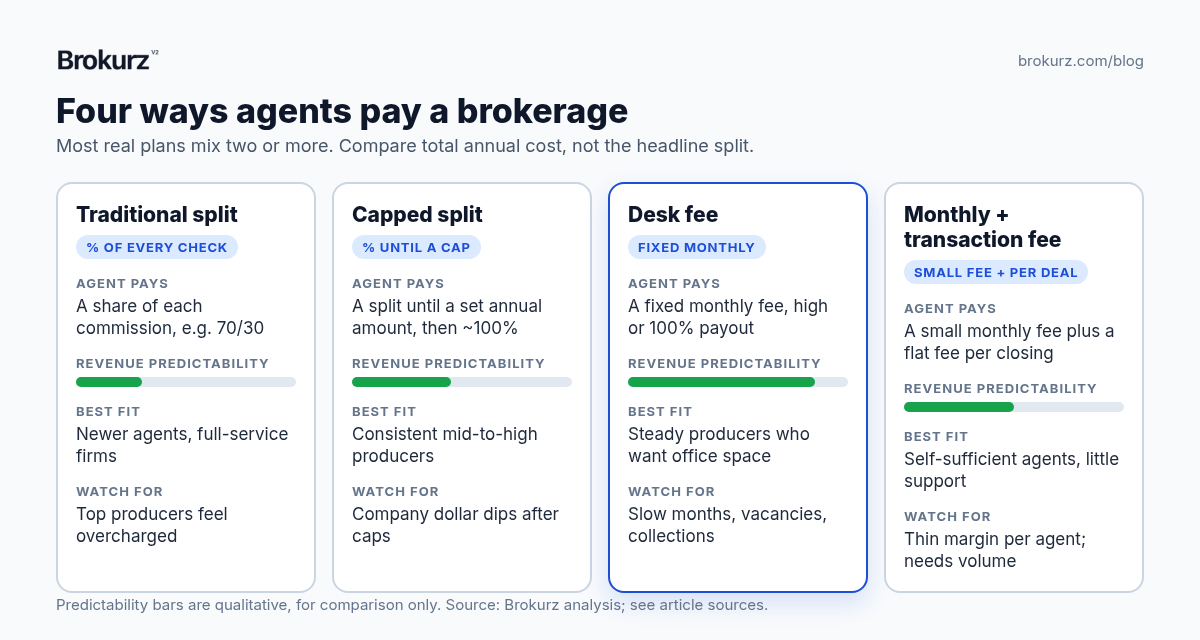
Here is how the four common ways of paying a brokerage compare. Most real plans mix two or more.
Model
How the agent pays
Brokerage revenue
Best fit
Main risk
Traditional split
A percentage of every commission (for example, 70/30)
Rises and falls with closings
Newer agents, full-service firms
High producers feel overcharged
Capped split
A split until the agent has paid a set annual amount, then 100% or close to it
Front-loaded in the agent's year, then drops
Consistent mid-to-high producers
Company dollar dips after caps hit
Desk fee
A fixed monthly fee, with a high or 100% payout
Predictable monthly, tied to seat count
Experienced, steady producers who want office space
Agents carry slow months; brokerage carries vacancies and collections
Low monthly fee plus transaction fee
A small monthly fee plus a flat fee per closing
Mostly tied to closings, low per agent
Self-sufficient agents who need little office support
Many brokerages that advertise "100% commission" today use a small monthly fee plus a per-transaction fee rather than a large classic desk fee. The table below shows what three brokerages publish on their own pages as of this writing. Fees vary by office and change over time, so treat this as a snapshot, not a quote.
HomeSmart Connect (Chicagoland and southern Wisconsin)
Realty ONE Group MVP
RE/MAX (as described by RealEstateNews, 2023)
Agent payout
100% of commission
100% of commission for eligible agents
95/5 split; traditional split options also offered
Monthly fee
$39 (single-state), $69 (Illinois and Wisconsin dual license)
$99 monthly brokerage fee
A separate monthly desk fee on the high-split option; amount not stated in the article
Per-transaction fee
$495 per closing
$399 per closed transaction
Not stated in the article
Cap on fees
Transaction fees stop at $9,000 a year, then $75 per transaction
Not stated on the fee page
Not stated in the article
Other published costs
$495 a year for E&O insurance
Subject to the agent's ICA and brokerage policies
All offices are independently owned franchises, so terms vary
Each of these is built for a different agent. HomeSmart Connect says its model is "volume based" and lists office access, a transaction coordinator, and training as included. Realty ONE Group's join page says it pairs 100% commission with coaching, technology, and marketing support, and its MVP office notes that fees and terms are "subject to the agent's Independent Contractor Agreement." RE/MAX built its brand on high splits for experienced, full-time agents. None of these is "best" in the abstract; the right fit depends on how much an agent sells and how much support they need.
Break-even math for agents
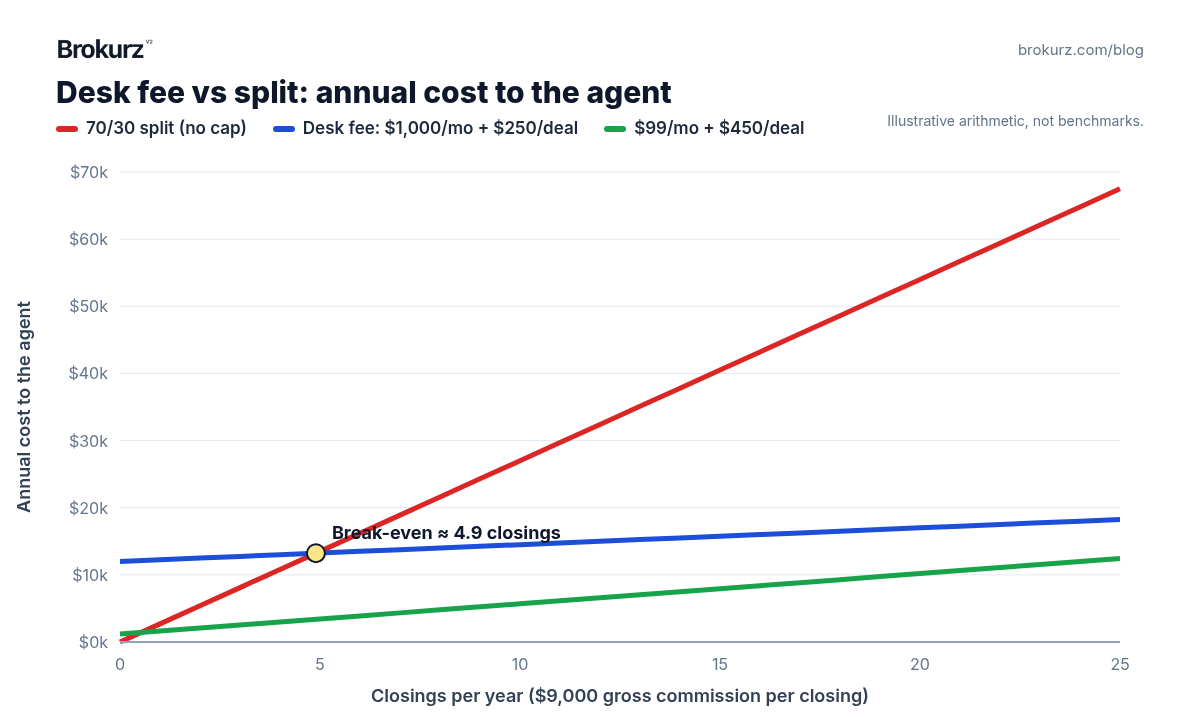
The question every agent asks about a desk fee is simple: at how many deals does it start paying off? Here is an illustrative example. Assume each closing produces $9,000 in gross commission for the agent's side, and compare three hypothetical offers:
Offer A, 70/30 split, no cap, no other fees. The brokerage keeps $2,700 per deal.
Offer B, classic desk fee. $1,000 a month ($12,000 a year) plus $250 per closing, 100% payout.
Offer C, low monthly plus transaction fee. $99 a month ($1,188 a year) plus $450 per closing, 100% payout.
Annual cost to the agent at different deal counts:
Closings per year
Offer A: 70/30 split
Offer B: desk fee
Offer C: monthly plus transaction fee
0
$0
$12,000
$1,188
3
$8,100
$12,750
$2,538
6
$16,200
$13,500
$3,888
10
$27,000
$14,500
$5,688
15
$40,500
$15,750
$7,938
25
$67,500
$18,250
$12,438
The break-even formula is the same for any two offers: fixed annual fees of the desk fee plan ÷ (cost per deal on the split − per-deal fee on the desk fee plan). In this example, $12,000 ÷ ($2,700 − $250) = about 4.9 deals. Under five closings, the split costs the agent less. From five up, the desk fee does.
For context, NAR's 2025 Member Profile reports that the typical agent had 10 transaction sides in 2024, and that REALTORS with two years or less of experience had a median gross income of $8,100. That spread is the whole story of the desk fee model: a plan that is a bargain for an established agent can be a real burden for a new one.
Two cautions keep this math honest:
Count what the split pays for. Under Offer A, the brokerage may be paying for marketing, leads, a transaction coordinator, and office costs that the agent would cover personally under Offer B or C. Ross's Inman example shows how quickly those costs add up.
Run a slow year, not just a good one. A desk fee is owed in a month with no closings, during a vacation, or during an illness. Ross raises exactly this question: how will a desk fee agent pay the monthly overhead if they cannot work?
Break-even math for broker-owners
On the brokerage side, a desk fee turns revenue into a function of filled seats. That makes the planning question "how many paying agents do I need to cover my fixed costs?"
Illustrative example: an office has fixed costs of $28,000 a month (rent, staff, technology, insurance, and the broker's own pay). It charges a $900 monthly desk fee.
Break-even seats: $28,000 ÷ $900 = 31.1, so 32 paying agents before any transaction fees.
With transaction fees: if the same office also charges $250 per closing and its agents close 400 deals a year (10 each across 40 agents), that adds about $8,333 a month and lowers the seats needed to cover fixed costs to about 22.
Collections matter as much as price: if 4 of 40 agents are behind on fees in a given month, the office collects $32,400 instead of $36,000. Late or missed desk fees are a direct hit to cash flow.
Compare this with a split model, where revenue arrives only when deals close but scales with production. Under a desk fee, your best producers pay the same as everyone else, so your revenue per agent is capped by the fee. Under a split, a top producer may generate far more company dollar, but also has more reason to leave for a cheaper plan. Our guide to brokerage profit margins and break-even agent counts covers the split side of this math.
Why some broker-owners like the desk fee model
Predictable cash flow. Revenue arrives monthly instead of in lumps at closing.
Lower risk from part-time agents. An agent who rarely closes still covers the cost of their seat.
A strong recruiting pitch to experienced agents. "Keep more of every check" is easy to explain, as RE/MAX's history shows.
Simple statements. A flat fee is easier for agents to understand than a split with multiple adjustments.
Why some broker-owners avoid it
Revenue per agent has a ceiling. Your biggest producers pay the same as average ones.
Newer agents struggle with fixed costs. Many offices pair a desk fee plan with a split plan for agents still building a business.
Vacancies hurt directly. Every empty seat is lost revenue against costs that do not shrink.
Collections take work. Someone has to bill, follow up, and decide what happens when an agent falls behind.
How to set your desk fee
If you decide to offer a desk fee plan, set the price from your costs, not from a competitor's flyer.
Add up fixed monthly costs for the office: rent, utilities, staff, technology, insurance, and broker compensation.
Decide what the fee includes. Write down which services are covered and which are billed separately (E&O, transaction fee, marketing, leads). Ambiguity here causes most fee disputes.
Estimate realistic seat count, not the number you hope to recruit. Price for the agents you have plus a conservative growth number.
Calculate cost per seat, then add a margin for profit and for the agents who will fall behind on payment.
Tier by space if you have it. Private office, shared workstation, and remote tiers, as Ross describes, let you charge for the space agents actually use.
Offer a path for newer agents. A split plan or a lower-fee plan with more support keeps you from recruiting only agents who already produce.
Put every fee in writing. The fee amounts, billing dates, late-payment terms, and what happens to fees owed when an agent leaves belong in the independent contractor agreement.
Automate billing and statements. Recurring fees, transaction fees, and payouts should come from the same records as the deals, so agents see one clear statement.
A note on agent status: per the IRS, licensed real estate agents are treated as statutory nonemployees for federal tax purposes if substantially all of their pay is directly related to sales or other output rather than hours worked, and they work under a written contract stating they will not be treated as employees. A desk fee is what the agent pays the brokerage, so it does not change how the agent is paid, but your written agreement still has to meet that standard. This is general information, not legal or tax advice; check with your state real estate commission, an attorney, and a CPA before changing your plans.
When a desk fee brokerage works: a scorecard
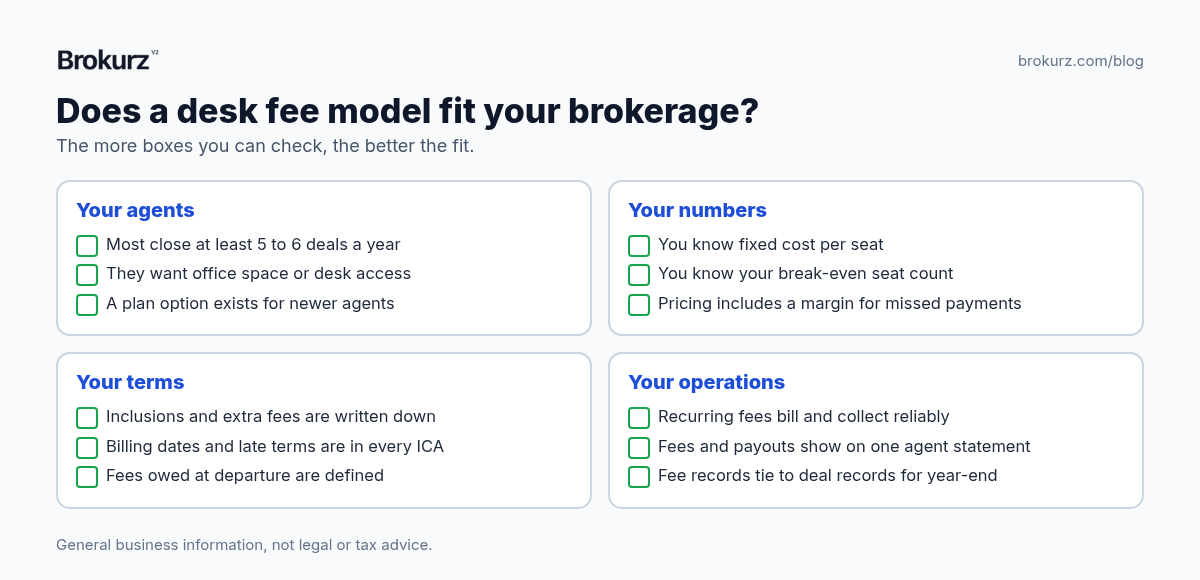
Score your brokerage on each line. The more "yes" answers, the better the fit.
Question
Why it matters
Do most of your agents close at least five to six deals a year?
Desk fees favor steady producers; below the break-even point, agents pay more than a split
Do agents actually want office space or desk access?
The classic model sells space; remote-first agents may prefer a lower monthly fee
Do you know your fixed cost per seat?
Without it, you cannot price the fee or know your break-even seat count
Can you bill and collect recurring fees reliably?
Missed fees hit cash flow immediately
Are fee terms written into every agreement?
Clear terms prevent disputes at departure and at year-end
Do you have a plan option for newer agents?
Fixed costs are hardest on agents still building a pipeline
Can agents see their fees and payouts on one statement?
Transparency is the main reason agents choose a flat-fee plan
Mistakes to avoid
Comparing headline splits. "100%" means little until every monthly, transaction, E&O, and franchise fee is added up.
Pricing from a competitor's number. Their rent, staff, and seat count are not yours.
Leaving inclusions vague. If the fee "includes marketing," define what that means.
Ignoring slow months. Agents in their first year, or any agent in a slow market, may not be able to carry a fixed fee.
No collections policy. Decide in advance how late fees, payment plans, and deductions from commission checks work, and put it in the agreement.
Running billing in a separate spreadsheet. When fee records live apart from deal records, statements drift and disputes follow.
Forgetting year-end. Recurring fees, transaction fees, and payouts all feed year-end reporting. Our brokerage year-end checklist covers what to reconcile.
Running a desk fee brokerage on Brokurz
Brokurz is the AI operating system for real estate: transactions, compliance, commissions, CRM, back office, website, and recruiting in one place. For a desk fee or hybrid plan, the practical benefit of one system is that agent plans, fees, transactions, and payouts sit together, so the numbers on an agent's statement come from the same records as their deals. That makes it easier to offer a desk fee plan next to a split plan, and to see what each one actually brings in.
Lock in today's rate before December 1. New customers who sign up by November 30 keep today's price; prices go up December 1, and existing customers keep their rate.
A desk fee is a fixed amount, usually monthly, that an agent pays a brokerage to work under its license, brand, and supervision. In exchange, the agent typically keeps a higher share of each commission, often 100% or close to it.
How much is a typical real estate desk fee?
There is no single standard, and published amounts vary widely by office and by what is included. Some brokerages that advertise 100% commission publish small monthly fees, such as $39 at HomeSmart Connect or $99 at Realty ONE Group MVP, plus per-transaction fees. Classic desk fees that include office space are usually higher. Always ask for the full fee schedule in writing.
Is a desk fee better than a commission split?
It depends on production. A desk fee is fixed, so it costs less than a split once an agent closes enough deals to cover it. In the illustrative example above, that point was about five closings a year. Below it, the split costs less. Also compare what each plan includes.
Do desk fee brokerages also charge transaction fees?
Often, yes. Many plans combine a monthly fee with a per-closing fee, and some add E&O, technology, or franchise fees. HomeSmart Connect, for example, publishes a $495 per-transaction fee and a $495 annual E&O charge alongside its monthly fee.
Do I still pay a desk fee if I don't close any deals?
In a desk fee plan, usually yes. The fee is fixed and owed whether or not you close. Check your agreement for how slow months, leaves of absence, and late payments are handled.
Does RE/MAX still charge a desk fee?
RE/MAX popularized the desk fee model when it was founded in 1973. According to RealEstateNews in 2023, RE/MAX now commonly uses a 95/5 split and also offers traditional split options for agents who don't want to pay a separate desk fee. Each RE/MAX office is independently owned, so terms vary by office.
How should a broker-owner set a desk fee?
Start with fixed monthly costs, divide by a realistic seat count to get cost per seat, add a margin for profit and missed payments, and define exactly what the fee includes. Many offices tier the fee by space (private office, workstation, remote) and keep a split plan for newer agents.
Can a brokerage offer both a desk fee and a split plan?
Yes, and many do. RE/MAX, for example, offers traditional split options next to its high-split plan. Offering both lets experienced agents choose a fixed cost while newer agents keep a variable one. Your back office needs to track each agent's plan accurately.
This guide is general business information, not legal, tax, or accounting advice. Brokerage fee rules and agreement requirements vary by state; check with your state real estate commission, an attorney, and a CPA.