Real Estate Transaction Fees: What Brokerages Charge and Why
Operations
Real Estate Transaction Fees: What Brokerages Charge and Why
A real estate transaction fee can be charged to the agent or the client. This guide covers published agent-side fees, client-side ranges, the legal picture after Freeman and the Compass case, and a disclosure checklist for broker-owners.
A real estate transaction fee is one of the smallest numbers in a home sale and one of the most argued about. It might be $50 taken out of an agent's commission for broker review, or a $495 line on a buyer's closing statement that nobody mentioned at the first showing. Both are called "transaction fees." They work differently, they are regulated differently, and they land on different people. In 2026 the client-paid kind moved from a back-office detail to a headline, with a Florida class action against Compass, a consumer report estimating that buyers and sellers pay nearly $2 billion a year in these fees, and Compass rolling out a flat fee nationwide.
This guide is for broker-owners deciding whether to charge a transaction fee, what to call it, how much to set it at, and how to disclose it so it holds up with clients, agents, and regulators. Agents comparing brokerage offers will also find the agent-side fee schedules useful. The thesis is simple: a transaction fee is a legitimate pricing tool when it is tied to real work, priced from real costs, and disclosed in writing before the client commits. It becomes a liability when any of those three is missing.
Scope note: this is general business information, not legal advice. Fee rules differ by state, and the legal questions here (RESPA, consumer protection, contract forms) are fact-specific. Check with your state real estate commission and an attorney before you change a fee or a form.
In this guide:
What a real estate transaction fee is (the two kinds)
How a real estate transaction fee works, step by step
The many names for the same fee
Agent-side fees: what brokerages publish
Client-side fees: what is known about amounts
The legal picture: RESPA, Freeman, state positions, and the Compass case
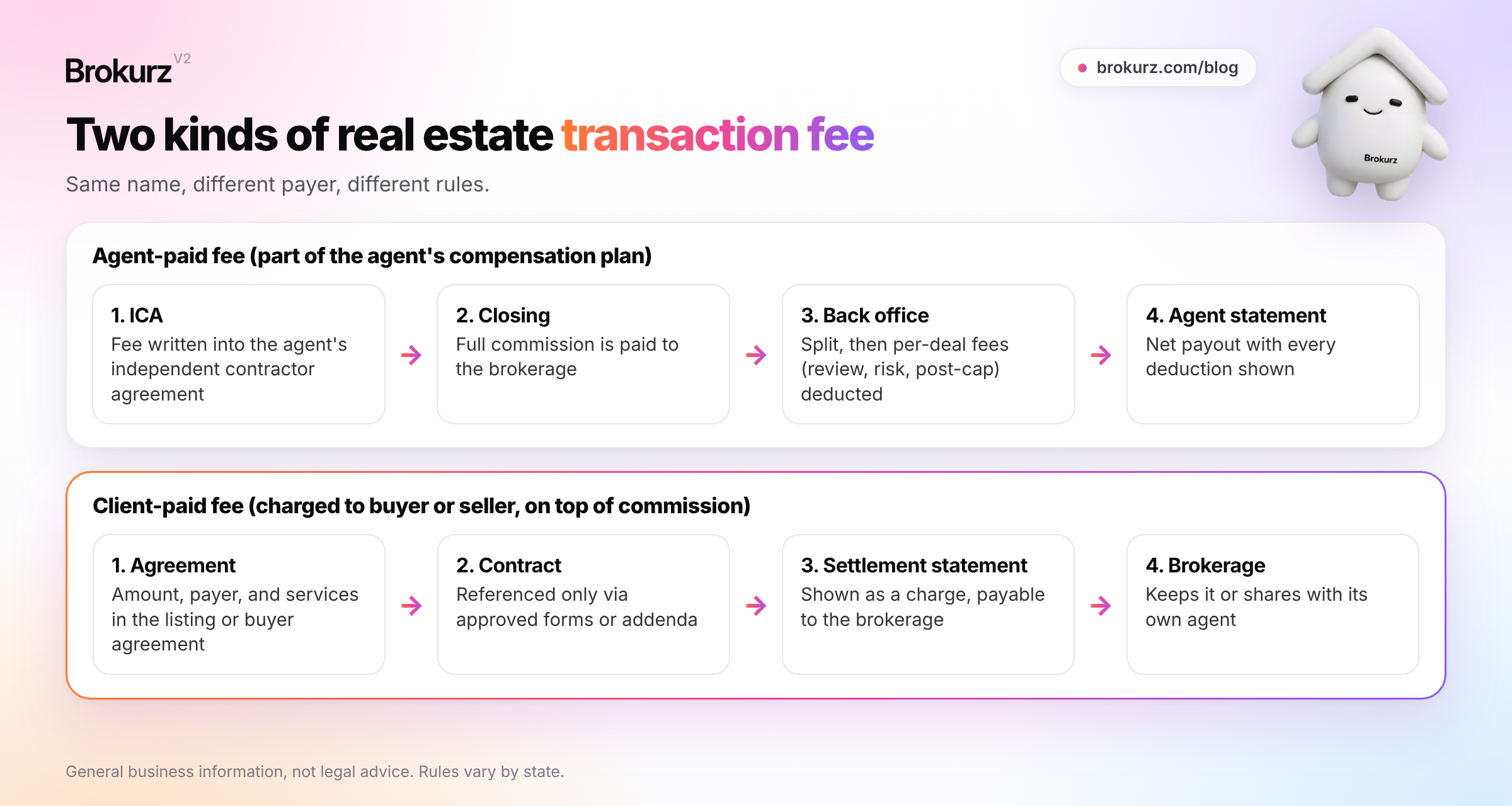
"Transaction fee" covers two different charges that happen to share a name.
1. The agent-paid transaction fee. This is a flat amount the brokerage deducts from the agent's share of the commission on each closed deal. It is part of the agent's compensation plan, written into the independent contractor agreement, and it never appears as a separate charge to the client. Low-split and capped brokerages lean on it heavily, because once an agent caps, the per-deal fee may be the brokerage's main revenue on that agent's deals. Common labels include broker review fee, compliance fee, risk management fee, and post-cap transaction fee.
2. The client-paid transaction fee. This is a flat amount charged to the buyer or seller, on top of the percentage commission, usually collected at closing and shown on the settlement statement. It is often called an administrative fee, admin fee, or broker compliance fee. Sometimes the brokerage requires agents to collect it from clients; sometimes the agent can choose to pay it out of their own commission instead.
The difference matters. The agent-paid fee is a deal between the brokerage and an independent contractor. The client-paid fee is a charge to a consumer, which brings in disclosure duties, consumer protection law, and, when a federally related mortgage is involved, federal settlement rules.
How a real estate transaction fee works
Here is how each kind moves through a typical closing.
Agent-paid fee, step by step:
The closing agent or attorney pays the full commission to the brokerage, never directly to the agent.
The brokerage's back office calculates the agent's split (if any), then deducts flat fees: broker review, risk management or E&O, and any post-cap transaction fee.
The agent receives the net amount and a commission statement that should show every deduction.
The fees roll up into the agent's year-end totals and the brokerage's company dollar.
Client-paid fee, step by step:
The fee and its amount are written into the listing agreement or buyer representation agreement at signing.
When there is an offer, the fee may also be referenced in the purchase contract or in the brokerage's commission instructions to the closing agent.
The fee appears on the settlement statement, charged to the buyer, the seller, or both, and is paid to the brokerage at closing.
The brokerage either keeps the fee or shares part of it with its own agent, under its internal compensation plan.
Step one is where most problems start or are prevented. A fee that first shows up in commission instructions a few days before closing is very hard to defend, even when the amount is reasonable.
The many names for the same fee
Part of the confusion is vocabulary. The Consumer Policy Center's July 2026 report on brokerage fees lists the labels its authors found in use: administrative or admin fee, transaction or realtor transaction fee, transaction coordinator fee, broker or broker service fee, broker administrative commission, document storage fee, processing fee, technology fee, and regulatory compliance fee. Compass's own earnings language, quoted by Real Estate News, calls its version a "flat transaction commission fee."
The name you choose should describe what the fee actually pays for. Calling a fee a "document storage fee" invites the obvious question of what document storage costs. Calling it part of the brokerage's compensation, and showing it next to the percentage commission, is easier to explain.
Agent-side fees: what brokerages publish
Large cloud and low-split brokerages publish their agent fee schedules, which makes them a useful benchmark for what a per-deal agent fee covers. The table below shows what two of them state on their own pages as of this writing. Fees change, and some vary by state, so treat this as a snapshot.
Fee
eXp Realty (U.S., per its income disclosure page)
Real Brokerage (U.S. agent plan, per its support center)
Split before cap
80/20 until a $16,000 annual cap
15% to Real until a $12,000 annual cap
Per-transaction fee on every deal
$25 broker review fee plus $60 risk management fee
$50 CBR (Compliance and Broker Review) fee
Fee after capping
"Subject to standard transaction fees"
$285 per sale and $125 per lease; $100 per sale after Elite Agent status (for transactions created on or after 9/1/2026)
Annual or monthly fees
$149 startup, $85 a month cloud brokerage fee
$249 sign-up, $900 annual brokerage fee taken as $300 from each of the first three transactions, no monthly fee
Personal transactions
Not listed on the income page
$250 per transaction, up to three per anniversary year
Two things stand out. First, both firms attach the per-deal fee to specific work: "broker review" and "risk management" at eXp, "compliance and broker review" at Real. Second, the post-cap fee is where the per-deal number gets meaningful. Real explains that its fees help cover operating costs while it offers "some of the industry's most competitive economic incentives." That is the honest trade: a lower split or a cap, paid for in part by per-deal fees.
Each model suits a different agent. eXp pairs a flat monthly fee with a modest per-deal charge. Real has no monthly fee, so a slow agent pays very little until they close. Neither fee schedule is a client charge; both come out of the agent's side of the commission.
Client-side fees: what is known about amounts
There is no official data set on client-paid admin fees. The best public snapshot is the Consumer Policy Center report by Stephen Brobeck and Wendy Gilch, which is based mainly on agent and broker comments and transaction documents its authors reviewed. Read its numbers as informed estimates, not a survey. Per the report:
Agents report that most fees fall between $400 and $600, with a range from under $200 to more than $2,000.
One industry insider's review of 24 recent transactions that included a fee found amounts from $195 to $1,590.
A Midwestern broker's review of twelve closings found fees on eleven, ranging from $395 to $799.
The authors roughly estimate that buyers and sellers pay nearly $2 billion a year in these fees, assuming half of buyers and sellers pay an average of $500.
Named examples from the Florida case: the closing statement filed with the Efron complaint shows a $475 buyer-side fee to Compass and a $495 seller-side fee to SERHANT, per Real Estate News.
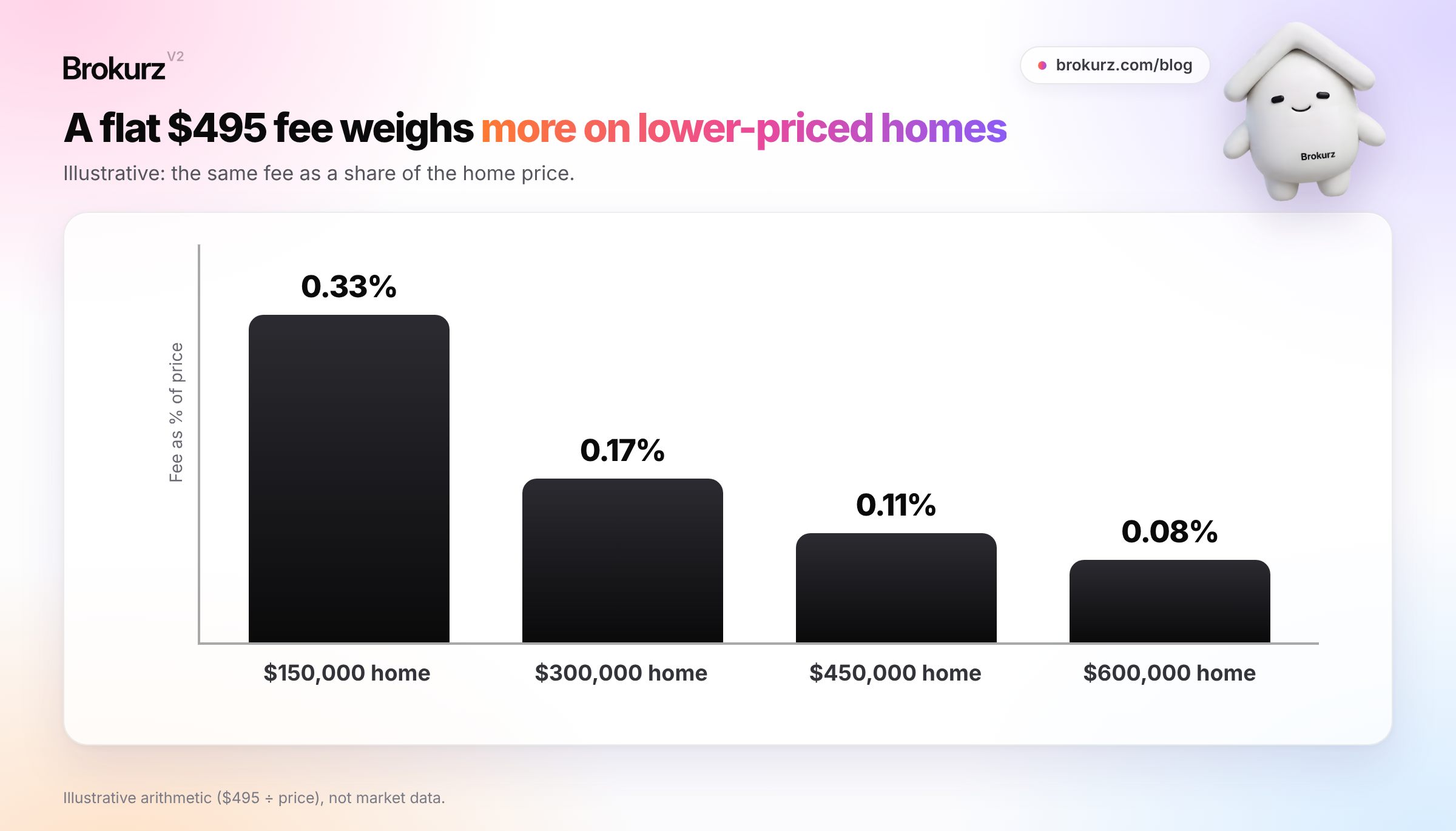
Because these fees are flat, they weigh more on lower-priced homes. The report points to a $1,590 fee on a $412,000 sale, which added about two-fifths of a percentage point to the effective commission, and a $795 fee on a $126,900 sale, which added about three-fifths of a point. The chart below applies the same arithmetic to an illustrative $495 fee.
The point for a broker-owner is not that the fee is wrong. It is that a first-time buyer on a $150,000 home will feel a $495 fee very differently from a move-up seller at $600,000, and your agents will have to explain it to both.
The legal picture: RESPA, Freeman, state positions, and the Compass case
Not legal advice. Check with your state and an attorney.
RESPA Section 8(b). The Real Estate Settlement Procedures Act says no person shall give or accept "any portion, split, or percentage of any charge made or received for the rendering of a real estate settlement service" in connection with a federally related mortgage loan, "other than for services actually performed" (12 U.S.C. § 2607(b)).
Freeman v. Quicken Loans (2012). The U.S. Supreme Court held that to establish a violation of § 2607(b), a plaintiff "must demonstrate that a charge for settlement services was divided between two or more persons." The Court said the provision "cannot be understood to reach a single provider's retention of an unearned fee." Freeman was a mortgage-fee case, but at least one state real estate regulator cites it on broker admin fees.
Colorado's position. The Colorado Real Estate Commission's Commission Position 2 on broker commissions states that, as a result of Freeman, brokerage firms "may charge administrative fees, either for services performed by the Broker or the Brokerage Firm, in addition to the Brokerage Firm's commission." It adds that a broker and their employing broker or brokerage firm are "considered a single provider of settlement services and fees may be split amongst them." Other states may take different positions, and state consumer protection law applies separately.
Disclosure still matters. RESPA is not the only question. The CFPB's 2014 action against RealtySouth, Alabama's largest real estate firm, resulted in a $500,000 civil penalty. That case was about affiliated business disclosures for title services rather than admin fees, but it shows that brokerage disclosure forms get enforcement attention. The CFPB said RESPA-required language had been "buried" in text that also made marketing claims.
The Compass case. In June 2026, Florida buyers Jeff and Milissa Efron filed a proposed class action against Compass Florida in Palm Beach County. Real Estate News reports they alleged a $475 fee was added to a Florida Realtors/Florida Bar approved purchase contract as an "additional term," and that they had been told their agents would be paid from the seller-paid commission. The complaint claimed violations of Florida consumer protection statutes and that modifying the approved form was the unauthorized practice of law. Compass said charging a transaction fee "has been standard practice in major markets for years, and is done by many other brands in the industry." On August 4, 2026, the plaintiffs voluntarily dismissed the case without prejudice, meaning it could be refiled. No court ruled on the merits.
Three practical takeaways for broker-owners:
Tie the fee to services your brokerage actually performs, and be able to list them.
Disclose it in the representation agreement, not first in the contract or at closing. Since the 2024 NAR settlement practice changes, buyer agreements are signed early, so there is a natural place to put it.
Use approved forms and approved methods to add terms. Have counsel review how your fee language is inserted into state forms.
When Real Estate News asked NAR about consumer transaction fees, a spokesperson pointed to the Code of Ethics requirement to explain and disclose "all contracts related to the transaction in clear and understandable language."
Why brokerages charge transaction fees
There are real reasons, and broker-owners should be able to state them plainly.
Compliance review costs money. Someone with a license reviews every file, contract, addendum, and disclosure. That work happens on every deal, whatever the price.
Risk is per-deal. E&O exposure, document retention, and audits scale with deal count, not commission size.
Splits got richer. The Consumer Policy Center report quotes a brokerage saying that firms competing for agents with large splits have shifted some of the cost to fees. Per-deal fees let a brokerage offer a competitive split or cap and still cover the fixed cost of supervising each transaction.
Flat costs suit flat fees. A $150,000 sale and a $900,000 sale need roughly the same compliance review. A flat fee recovers that cost more evenly than a percentage.
There are also real costs to charging clients: agents who dislike explaining it, clients who negotiate it away, and the reputational risk the 2026 coverage shows. The same report notes that some agents choose to pay the fee themselves rather than pass it on. Many brokerages resolve this by charging the agent, not the client, or by folding the amount into the quoted commission.
How to set a transaction fee from your costs
Price the fee from the work it pays for. Here is an illustrative worksheet for a brokerage that closes 300 transaction sides a year. The numbers are examples for the method, not benchmarks.
Cost tied to each transaction
Annual cost (illustrative)
Compliance and broker review staff time
$48,000
Transaction management, e-signature, and file storage
$9,600
E&O program cost not already billed to agents
$14,400
Total per-transaction costs
$72,000
÷ closed sides per year
300
Cost per closed side
$240
From there, decide three things:
Who pays. Agent-paid (deducted from commission), client-paid (on the settlement statement), or agent's choice. Agent-paid is simplest to disclose; client-paid needs the most care.
How much margin. A fee near your real cost per side is easy to defend as "for services actually performed." A fee far above cost is a revenue line, and should be presented as part of your compensation.
What changes it. Leases, referrals, personal transactions, and dual agency are the usual exceptions. Real, for example, publishes separate lease and personal-transaction fees and charges its CBR fee on each side of a dual-representation deal.
Revisit the number every year, alongside your year-end close. Our brokerage year-end checklist includes reviewing fee schedules before you send 2027 agreements.
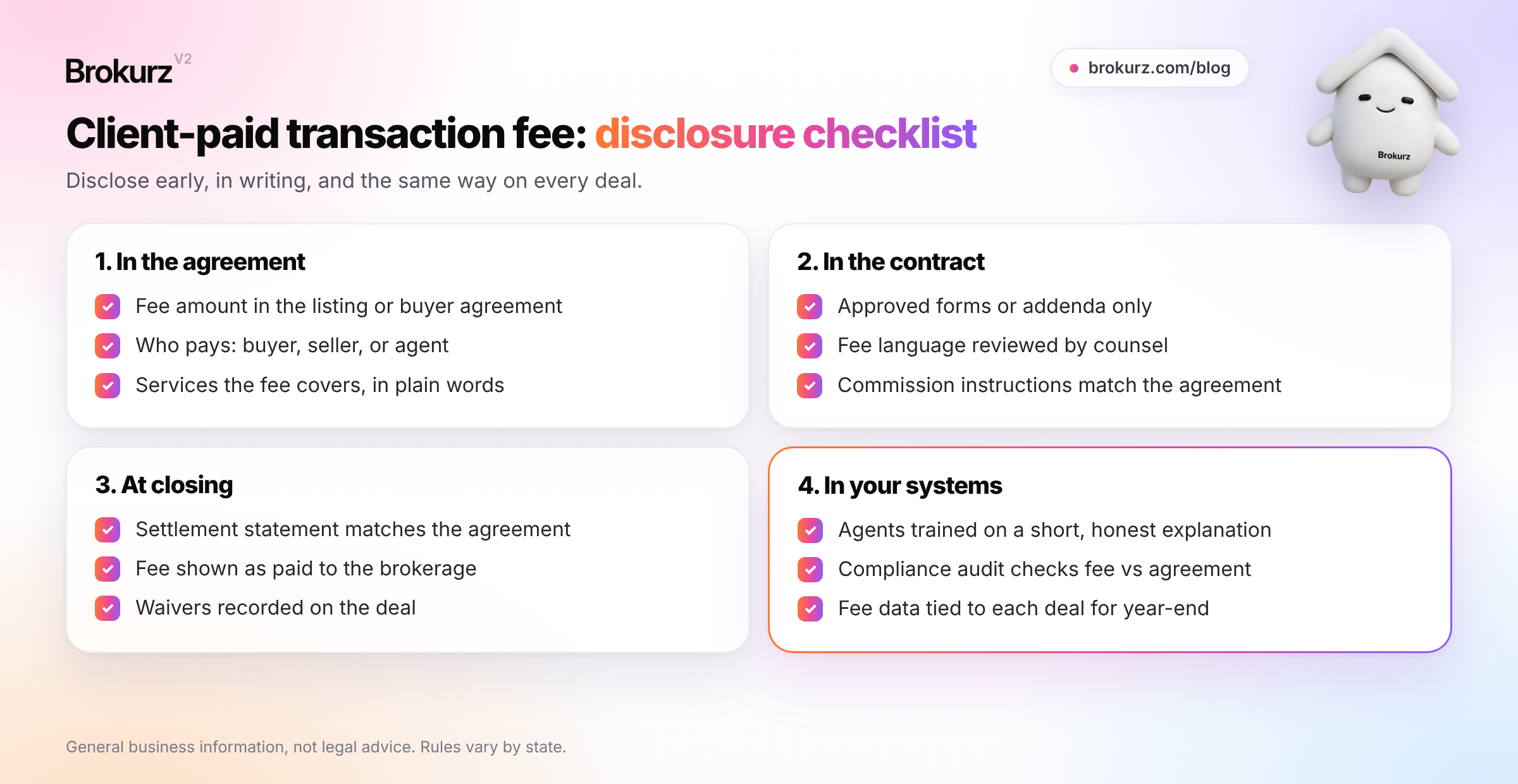
A disclosure checklist for client-paid fees
If you charge clients, these steps keep the fee clean.
The fee amount is in the listing agreement or buyer representation agreement, signed before showings or listing.
The agreement says who pays (buyer, seller, or agent) and what services the fee covers.
Agents use the same fee language every time, from a brokerage template.
Any reference in a purchase contract uses an approved form or addendum, reviewed by counsel.
Commission instructions to the closing agent match the signed agreement.
The settlement statement shows the fee as paid to the brokerage.
Agents are trained on a short, honest explanation of the fee.
Compliance audits check that the fee on the settlement statement matches the agreement.
Waivers and agent-paid exceptions are recorded on the deal, not handled by email.
Mistakes to avoid and a fee scorecard
Common mistakes:
Disclosing late. Adding a fee to commission instructions days before closing is the pattern the Consumer Policy Center report says makes brokers "especially likely to be sued," and it is close to what the Efron complaint alleged.
Vague names. "Processing fee" with no listed services invites the question "what processing?"
Letting agents freelance. The report describes agents adding their own amounts on top of the broker's fee. Set one schedule and enforce it.
Inconsistent waivers. If some agents waive the fee and others do not, keep a record of who paid and why. Inconsistency confuses statements and makes year-end reconciliations harder.
Hiding agent-side fees. Agents who discover a fee on their first commission statement leave. Put every per-deal deduction in the ICA and on a one-page fee sheet.
Never revisiting the amount. Costs change. A fee set years ago may be well above or below your current cost per side.
Scorecard: rate your current fee, one point each.
Question
Yes = 1
Can you list the services the fee pays for?
Is the amount within a reasonable margin of your cost per side?
Is it disclosed in the representation agreement before showings or listing?
Do agents use standard, counsel-reviewed language?
Does the settlement statement always match the agreement?
Are waivers and exceptions recorded on the deal?
Does every agent-side deduction appear in the ICA and on commission statements?
Did you review the fee in the last 12 months?
A score of 7 or 8 means your fee is defensible and well run. 4 to 6 means fix the gaps before your next agreement cycle. Under 4, pause and get legal review before you charge it again.
How Brokurz helps you run transaction fees cleanly
Brokurz is the AI operating system for real estate: transactions, compliance, commissions, CRM, back office, website, and recruiting in one place. Transaction fees touch almost all of those. The fee is set in the agent's plan, disclosed in the client agreement, checked in compliance review, deducted or collected at closing, shown on the commission statement, and reconciled at year-end. When those steps live in separate tools, the fee on the settlement statement and the fee on the agent's statement can drift apart. Running them in one system keeps plans, transactions, compliance, and payouts on the same records, so your fee schedule is applied the same way on every deal.
Lock in today's rate before December 1. New customers who sign up by November 30 keep today's price; prices go up December 1, and existing customers keep their rate.
It is a flat fee charged per deal, separate from the percentage commission. An agent-paid transaction fee is deducted from the agent's commission by the brokerage. A client-paid transaction fee, often called an admin fee, is charged to the buyer or seller and usually collected at closing.
How much is a typical real estate transaction fee?
On the agent side, published schedules range from small per-deal charges, such as Real's $50 CBR fee or eXp's $25 broker review and $60 risk management fees, to post-cap fees like Real's $285 per sale. On the client side, the Consumer Policy Center report says agents describe most fees as $400 to $600, with a range from under $200 to more than $2,000.
Is a real estate admin fee legal?
In many places, yes, when it is for services the brokerage actually performs and is properly disclosed. Colorado's Real Estate Commission, citing Freeman v. Quicken Loans, says brokerage firms may charge administrative fees in addition to their commission. State consumer protection and disclosure rules still apply, so check your state's rules and get legal advice.
Can a buyer or seller negotiate the transaction fee?
Often, yes. The fee is part of the brokerage's compensation, and compensation is negotiable. Some brokerages let agents pay the fee themselves, and the Consumer Policy Center report notes that some agents choose to. Brokerages should decide in advance who can approve a waiver and record it on the deal.
Who pays the transaction fee, the agent or the client?
It depends on the brokerage and the fee. Agent-side fees, like broker review or post-cap fees, come out of the agent's commission. Client-paid admin fees are charged to the buyer, the seller, or both, and should be stated in the representation agreement.
Where does a transaction fee appear on the closing documents?
A client-paid fee normally appears on the settlement statement as a charge to the buyer or seller, payable to the brokerage. Agent-paid fees do not appear on the client's documents; they show on the agent's commission statement from the brokerage.
What happened in the Compass transaction fee lawsuit?
In June 2026, Florida buyers filed a proposed class action alleging Compass Florida added an undisclosed $475 fee to their purchase contract. Compass said such fees are standard practice in many markets. The plaintiffs voluntarily dismissed the case without prejudice on August 4, 2026, so no court ruled on the claims.
Should my brokerage charge clients a transaction fee?
It is a business decision. If you do, price it from your real per-deal costs, tie it to specific services, disclose it in the representation agreement, and train agents to explain it. Many brokerages instead charge per-deal fees to agents or fold the amount into the quoted commission.
This guide is general business information, not legal, tax, or accounting advice. Fee rules, disclosure requirements, and approved forms vary by state; check with your state real estate commission and an attorney before changing fees or agreements.