Slow Real Estate Market: What It Means for Brokerages
Operations
Slow Real Estate Market: What October's 16-Year Sales Low Means for Brokerages
Existing-home sales fell to a 3.75 million pace in October 2026, the slowest since 2010. Here is what the slow real estate market means for brokerage revenue, the numbers to watch, and what broker-owners should do this week.
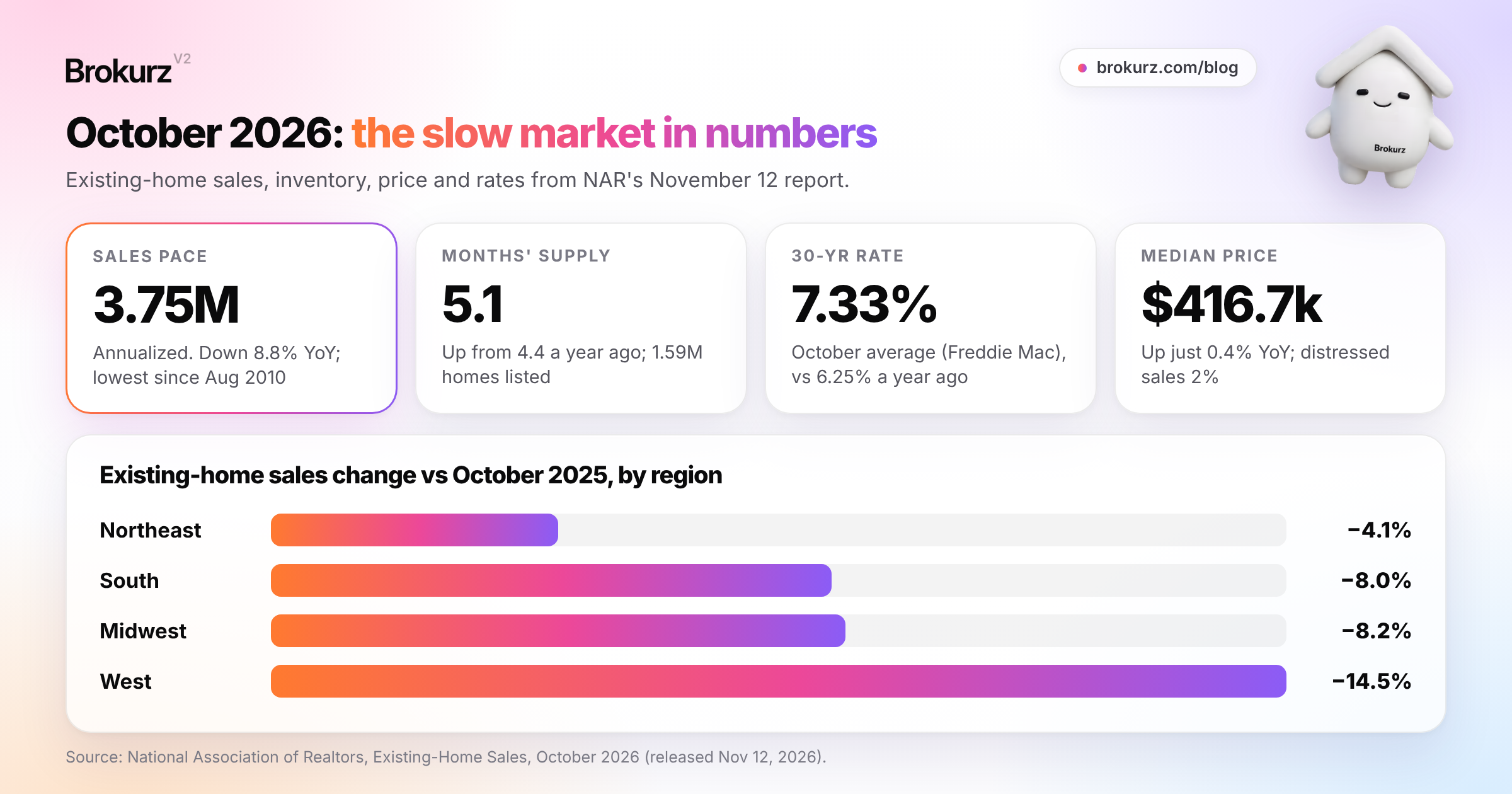
The slow real estate market just got a number. On November 12, 2026, the National Association of Realtors reported that existing-home sales fell 5.5% in October to a seasonally adjusted annual rate of 3.75 million, down 8.8% from a year earlier and the lowest pace since August 2010. Inventory rose to a 5.1-month supply, the average 30-year mortgage rate in October was 7.33% per Freddie Mac, and Redfin estimates sellers now outnumber buyers by 70.5%, the widest gap in its records.
For a broker-owner, that is not a headline. It is next quarter's revenue.
The thesis of this guide: this is a volume problem, not a price crash, and brokerages that treat it as a volume problem will come out of the winter stronger. Prices are flat, distressed sales are rare, and homeowners are sitting on equity. What has disappeared is transaction count. A brokerage's income tracks transaction count closely, and most of its costs do not. The firms that re-forecast now, cut the costs that do not earn their keep, and keep their productive agents busy will be the ones recruiting in spring, not the ones being acquired.
This guide is for owners and managing brokers of residential brokerages, from 10-agent independents to multi-office firms. Team leaders running their own P&L will find the same math applies.
Scope note: this is general business information, not financial, tax, or legal advice. Your local market may look very different from the national numbers, so pull your own MLS data before you make staffing or pricing decisions.
In this guide:
The October 2026 numbers in one table
Why this slow real estate market is different
What a slow market does to brokerage economics (with a worked example)
The regional split matters if you operate in more than one market. Per NAR, sales in the West fell 9.7% month over month and 14.5% year over year. The South fell 6.5% month over month and 8% year over year. The Midwest fell 3.2% month over month and 8.2% year over year. The Northeast was flat month over month and down 4.1% year over year, with its median price up 3.2%.
To put 3.75 million in context: NAR's own Pending Home Sales Index methodology notes that sales volume of 5.0 to 5.5 million is "considered normal for the current U.S. population." October's pace is roughly 25% to 32% below that range.
Why this slow real estate market is different
Every slow real estate market feels the same at the closing table: fewer of them. But the cause shapes the right response, and this one has three features worth naming.
1. It is rate-driven, not credit-driven. NAR Chief Economist Lawrence Yun said in the October release that "mortgage rates have climbed to their highest levels since 2000, aside from a single month in 2023." Freddie Mac's monthly average went from 6.25% a year ago to 7.33% in October. That is a sharp move in a short window, and it showed up first in contracts: NAR reported on October 20 that pending home sales fell 7.3% in September and 11.3% year over year, with declines in all four regions. NAR notes that pending sales usually close within one or two months, so October's closings were already baked in by September's contract count.
2. Inventory is building, and buyers have leverage. Months' supply rose from 4.4 a year ago to 5.1. TD Economics, reading the same NAR data, noted that single-family supply on a seasonally adjusted basis is now moving "further into the four-to-six-month range typically considered balanced." Redfin goes further: in its October analysis, reported by RISMedia on November 16, Redfin estimated 70.5% more sellers than buyers nationally, the sixth straight monthly record, and found only three seller's markets among the 50 most populous metros (Nassau County, New York; Newark, New Jersey; and Montgomery County, Pennsylvania). Redfin Senior Economist Asad Khan said sellers are "increasingly competing for buyers' attention," leading to more price reductions and concessions.
3. It is not a distressed market. Distressed sales were 2% of October transactions per NAR, and the median price was still up slightly year over year. Yun pointed to "88 million homeowners" in a comfortable financial position and said there "could be sizable pent-up demand if mortgage rates decline."
What that means for your brokerage: you are not preparing for a wave of short sales and REO work. You are preparing for a stretch where listings take longer, sellers need more coaching on price, buyers negotiate harder, and each agent closes fewer deals. That is an operations and coaching problem, and it is very manageable if you plan for it.
What a slow real estate market does to brokerage economics
A brokerage earns on transactions and pays most of its bills by the month. Rent, salaries, software, insurance, and marketing do not shrink when closings do. That gap between variable revenue and fixed cost is operating leverage, and it works against you in a down market.
A quick sense of scale: NAR counted 1,438,569 members in its 2026 Member Profile (June 2026). At October's 3.75 million annual pace, and with two sides per sale, there are about 7.5 million transaction sides a year to go around. That works out to roughly five sides per NAR member per year, before accounting for sales outside the MLS or agents who are not Realtors. It is rough math, but it explains why so many agents feel stretched. The same NAR profile reported that the typical agent individually closed nine sides in 2025 and that team-based brokerage specialists reported a median of 32.
A worked example (illustrative)
The numbers below are a hypothetical brokerage, not a real firm, built to show the shape of the problem. Plug in your own figures.
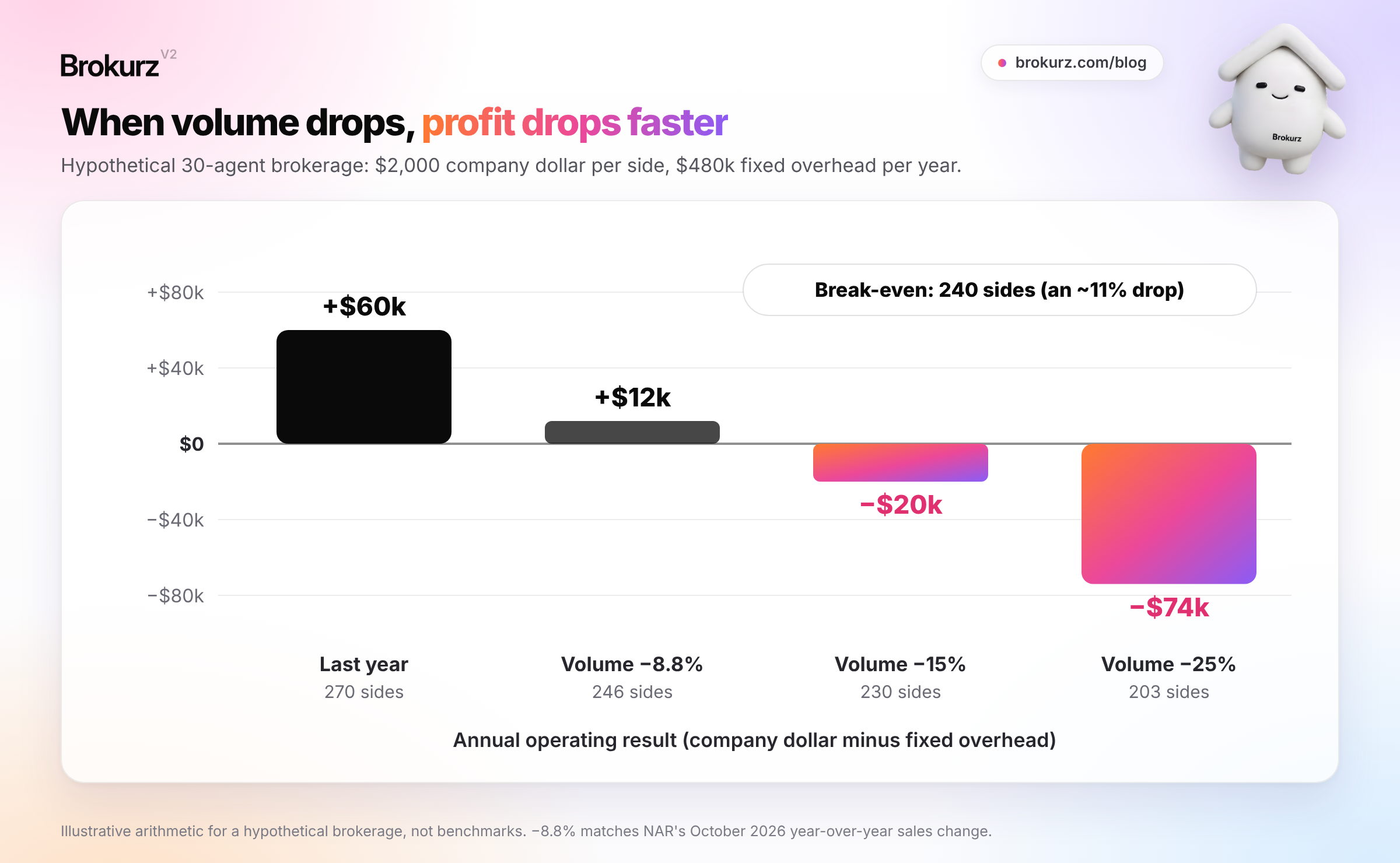
Assumptions: 30 agents, 270 sides last year (nine per agent, in line with NAR's typical individual figure), $2,000 of company dollar per side after agent splits, and $40,000 a month in fixed overhead ($480,000 a year).
Scenario
Sides
Company dollar
Fixed overhead
Operating result
Last year
270
$540,000
$480,000
+$60,000
Volume down 8.8% (October's national YoY drop)
246
$492,000
$480,000
+$12,000
Volume down 15%
230
$460,000
$480,000
-$20,000
Volume down 25%
203
$406,000
$480,000
-$74,000
In this example, break-even is 240 sides. An 11% drop in volume erases the year's profit. A 25% drop turns a healthy firm into one losing about $6,000 a month.
Three takeaways from the math:
Profit is more fragile than revenue. Revenue fell 8.8% in the second scenario. Profit fell 80%.
Fixed costs are the lever you control. You cannot make buyers apply for mortgages, but you can decide what you pay for every month.
Agent productivity matters more than headcount. Ten agents doing 20 sides each produce the same company dollar as 40 agents doing five, with far less support cost per deal.
If you are not sure what your company dollar per side is, our company dollar guide walks through how to calculate it from your commission records.
Five numbers to watch through the winter
Do not wait for the next headline to tell you how your quarter is going. Put these on one page and look at them every week.
Pending home sales (NAR, monthly). This is the leading indicator. NAR says pending contracts usually close within one to two months, so it tells you what the next 60 days of closings look like nationally.
Freddie Mac's 30-year rate (weekly, Thursdays). As of November 12, 2026, the 30-year fixed averaged 7.11%, down from 7.18% the prior week and the fourth straight weekly decline, per Freddie Mac. A year earlier it was 6.24%. Watch the direction, not the decimal.
Months' supply in your MLS. Nationally it is 5.1 months. If your market moves past six, listing agents need tighter pricing conversations and sellers need concession strategies.
Median days on market. NAR reported 35 days in October. Track your own office's average days on market against your MLS. If your listings sit longer than the market, that is a pricing or marketing issue you can fix.
Your own pipeline. Count active listings, signed buyer agreements, accepted offers, and deals scheduled to close in the next 30, 60, and 90 days. This is the only forecast that is actually about your business.
What to do this week: a broker-owner checklist
You can do every item on this list in five working days. None of it requires a consultant.
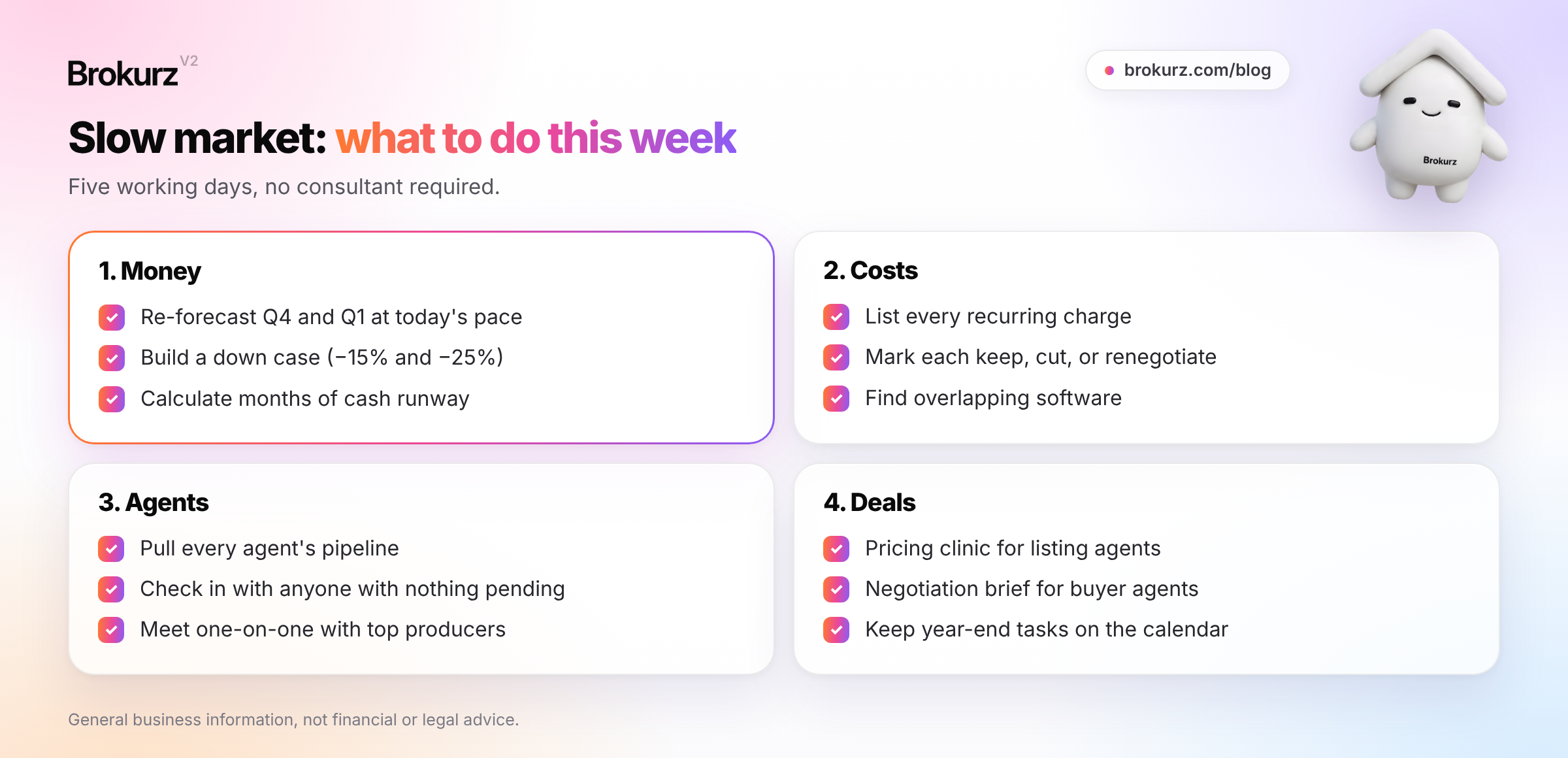
Re-forecast Q4 and Q1 at today's pace. Take your pending deals, apply your historical fall-through rate, and build a base case and a down case (for example, 15% and 25% below last year).
Calculate months of runway. Cash on hand divided by your monthly fixed overhead minus expected company dollar. Know the number before your banker or partner asks.
Run a fixed-cost audit. List every recurring charge: rent, salaries, software seats, lead subscriptions, sponsorships. Mark each one keep, cut, or renegotiate.
Count your software overlap. Many brokerages pay for more than one tool that does the same job. (More on this below.)
Pull the pipeline for every agent. Sort agents by deals under contract and active listings. Book 15-minute check-ins with anyone who has nothing pending.
Run a pricing clinic for listing agents. Bring your MLS days-on-market and price-reduction data. Sellers who priced for last spring need a new conversation.
Brief buyer agents on negotiation. In a buyer's market, concessions, repairs, and rate buydowns are on the table. Make sure every buyer agent knows how to ask and how to document it.
Check transaction fee and agent fee timing. If agents owe monthly fees, decide now how you will handle hardship cases so you are consistent.
Confirm your year-end tasks are on the calendar. A slow market is no excuse to miss 1099s or license renewals. Our brokerage year-end checklist covers them.
The tech stack is the easiest place to start
Large firms are already doing this. In its Q3 2026 earnings call, reported by HousingWire on November 5, Real REMAX Group said it had found more than $40 million in annualized gross cost savings after its merger, reduced combined headcount by more than 14%, and is "consolidating technology systems, vendor relationships and other duplicative costs." Executives also said they see ways to create value "that do not require a housing recovery."
You do not need a merger to apply the same logic. If you are paying separately for a CRM, a transaction management tool, a commission tracker, a website vendor, and a recruiting tool, the overlap is real money every month. Our guide to cutting brokerage tech stack sprawl has a worksheet for it.
A 30/60/90-day plan
Window
Focus
Concrete actions
Next 30 days
Protect cash and pipeline
Re-forecast, cut or pause non-earning costs, check in with every agent, run pricing and negotiation clinics, set weekly pipeline reviews
31 to 60 days
Raise productivity
Pair low-producers with mentors or teams, set activity targets (conversations, appointments, listings taken), clean up the CRM so every past client gets a touch before the new year
61 to 90 days
Position for spring
Recruit productive agents who are unhappy elsewhere, lock in 2027 commission plan changes, publish your 2027 budget with a down-case scenario, plan spring listing campaigns
The point of the 90-day window is that the market may not recover in that time, but your brokerage can be meaningfully better run by the end of it.
Recruiting and retention when deals are scarce
A slow market reshuffles agents. Some leave the business, some consolidate into teams, and some move to firms with better economics or better support.
The data so far points to a gradual shakeout rather than a collapse. NAR's 2026 Member Profile found that 75% of members are "very certain" they will remain active for at least two more years, and the typical Realtor now has 13 years of experience. NAR also reported median gross income of $59,200 against median business expenses of $9,530, and a median tenure of six years with the current firm.
Agent counts are still moving at the brand level. HousingWire reported that REMAX's U.S. and Canada agent count fell 3% year over year to 72,118 in Q3, and that Real offboarded more than 500 agents for unpaid dues or expired licenses in early November. Local news is full of teams changing brokerages, and that kind of movement tends to pick up when deals get harder to find.
What to do with that:
Retain your producers first. In many brokerages, a small group of agents produces a large share of company dollar. Ask each of them, directly, what would make them stay through 2027. See our agent retention guide.
Recruit for production, not headcount. In a slow real estate market, an agent who closes 15 sides a year is worth more than five agents who close two each. Our recruiting guide covers how to run those conversations.
Lean into teams. NAR found 21% of Realtors work on teams, and team-based brokerage specialists reported a median of 32 sides. A well-run team can absorb newer agents who would otherwise wash out.
Do not lower standards to fill seats. Agents who cannot pay fees or keep licenses current cost money in support and compliance risk.
Mistakes to avoid and a scorecard
The most common mistakes in a slow market are predictable:
Waiting for rates to fix it. TD Economics noted that mortgage rates "have repeatedly defied expectations for a sustained decline in recent years." Plan for higher-for-longer and treat any relief as upside.
Cutting the wrong things. Cutting agent training or compliance review saves little and costs a lot. Cutting duplicate software saves real money with no downside.
Across-the-board split changes. Changing everyone's split mid-year to make up revenue tends to push out your best agents first.
Ignoring the listing side. In a buyer's market, overpriced listings sit, frustrate sellers, and damage your brand. Coaching on price is revenue protection.
Flying blind. If you cannot see your pipeline, company dollar per side, and cash runway in one place, you are guessing.
Score your brokerage. Give yourself one point for each "yes":
Question
Yes / No
Do you know your company dollar per side for the last 12 months?
Do you have a written down-case forecast for Q1 2027?
Can you see every agent's pending deals and active listings today?
Have you reviewed every recurring software charge in the last 90 days?
Do you know your months of cash runway?
Have you met one-on-one with your top five producers this quarter?
Do your listing agents have current local days-on-market and price-reduction data?
Is your 2027 commission plan decided and ready to announce?
7 to 8: you are well positioned. 4 to 6: pick the missing items and finish them this month. 0 to 3: start with the checklist above this week.
Where the market could go next
Nobody knows when rates will move, and anyone who says otherwise is guessing. Here is what the sources say:
Rates have started to ease. Freddie Mac's weekly average fell for four straight weeks to 7.11% as of November 12. Freddie Mac Chief Economist Sam Khater called it "the lowest level in seven weeks."
The near term still looks weak. TD Economics said sales "are likely to remain exceptionally weak over the near term," with a baseline that sees rates gradually easing toward 6% over the medium term.
Demand is waiting, not gone. NAR's Yun pointed to "sizable pent-up demand if mortgage rates decline," and Redfin's Khan said first-time buyers who can afford today's costs "may have an opportunity to make a move" in a historic buyer's market.
The practical read for broker-owners: plan your budget for a slow first quarter, but keep your best agents, your database, and your listing pipeline ready for a fast turn if rates drop. The brokerages that cut so deep they cannot respond will miss the recovery.
How Brokurz helps you run a brokerage in a slow market
Brokurz is the AI operating system for real estate: transactions, compliance, commissions, CRM, back office, website, and recruiting in one place. In a slow market, that matters for three reasons.
One view of the pipeline. Listings, deals under contract, and closings live in the same system as your agents and commissions, so the weekly pipeline review on the checklist above is a report, not a spreadsheet project.
Commission and company dollar visibility. When commissions run through the same system as transactions, you can see what each deal and each agent actually contributes to the brokerage.
Fewer tools to pay for. Running CRM, transactions, compliance, back office, website, and recruiting together is one of the most direct ways to act on the fixed-cost audit.
Lock in today's rate before December 1. New customers who sign up by November 30 keep today's price; prices go up December 1, and existing customers keep their rate.
Per NAR's November 12, 2026 report, existing-home sales ran at a seasonally adjusted annual rate of 3.75 million in October, down 8.8% from a year earlier and the slowest pace since August 2010. Inventory rose to a 5.1-month supply.
Is this a housing crash?
The data does not describe a price crash. NAR reported the median existing-home price at $416,700, up 0.4% year over year, and distressed sales at just 2% of transactions. The decline is in the number of sales, driven mainly by mortgage rates.
Why are home sales so low in late 2026?
Affordability. Freddie Mac's 30-year fixed rate averaged 7.33% in October, up from 6.25% a year earlier, according to NAR. NAR's Housing Affordability Index fell to 100.7 from 107.3. Pending contracts had already dropped 7.3% in September.
Is it a buyer's market?
In most places, yes. Redfin estimated there were 70.5% more sellers than buyers in October, a record in data going back to 2013, and only three of the 50 most populous metros were seller's markets, all in the Northeast.
What should a brokerage do first in a slow real estate market?
Re-forecast the next two quarters at today's pace, calculate your cash runway, and audit fixed costs, starting with duplicate software. Then check in with every agent who has nothing pending and coach listing agents on pricing.
Should I cut agent splits to make up for lost revenue?
Be careful. Across-the-board split changes mid-year tend to push out productive agents first. It is usually better to reduce fixed costs and raise productivity, then make deliberate changes in your 2027 commission plan with plenty of notice.
When will the market recover?
No one can say with confidence. TD Economics expects sales to stay weak in the near term, with rates gradually easing toward 6% over the medium term, and noted that rates have repeatedly defied forecasts. Plan for a slow start to 2027 and stay ready for a faster turn.
Is a slow market a good time to recruit agents?
It can be. Agents re-evaluate their brokerage when deals are scarce, and teams and brokerages are actively moving. Focus on productive agents and teams rather than raw headcount.